October 28, 2026
The Leader’s Journey
Understanding God’s Lifelong Process of Development
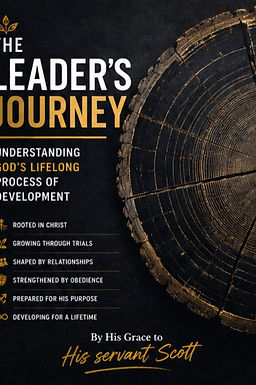
One of the greatest gifts a servant leader can receive is the understanding that God is developing him for a lifetime. Many enter ministry believing that leadership is primarily about learning skills, gaining knowledge, or finding opportunities to serve. While those things are important, God’s primary concern is not what we do for Him but who we become in Him. The Lord is always far more interested in our character than our platform, our surrender than our success, and our obedience than our accomplishments. When a servant leader understands this truth, he becomes less frustrated by delays, difficulties, and seasons of obscurity because he realizes that development is not a detour from God’s plan—it is God’s plan.
Throughout Scripture, we see that God never rushes the development of His leaders. Abraham received a promise but waited decades before seeing its fulfillment. Joseph received dreams from God, yet his path led through betrayal, slavery, and prison before he ever sat on the throne of Egypt. Moses spent forty years in the wilderness learning dependence before leading Israel out of bondage. David was anointed king while still a shepherd boy, but years passed before he ever wore the crown. Even Jesus spent thirty years in preparation for three years of public ministry. God’s methods have not changed. He still develops leaders through time. James reminds us, “And let endurance have its perfect result, so that you may be perfect and complete, lacking in nothing” (James 1:4). The servant leader who understands this learns to trust God’s timetable instead of demanding his own.
One of God’s favorite tools in leadership development is brokenness. This is often the stage that many leaders resist because it is uncomfortable and sometimes painful. Yet throughout Scripture, God consistently breaks self-reliance before releasing spiritual authority. Jacob wrestled with God and walked with a limp afterward. Peter’s confidence in his own strength collapsed when he denied Christ three times. Paul carried a thorn in the flesh that continually reminded him of his dependence upon God’s grace. Brokenness is not God’s rejection of a leader; it is His preparation of a leader. Psalm 51:17 says, “The sacrifices of God are a broken spirit; a broken and a contrite heart, O God, You will not despise.” God often breaks what He intends to use because pride cannot carry the weight of His glory.
The Lord also develops servant leaders through obscurity. Most of God’s greatest work in a leader’s life happens when nobody is watching. David learned faithfulness while tending sheep in lonely fields. Elisha spent years serving Elijah before receiving a double portion. Jesus lived quietly as a carpenter before beginning His public ministry. In our culture, people often seek visibility, but God seeks faithfulness. He is not impressed by public recognition; He is looking for private obedience. Jesus said, “He who is faithful in a very little thing is faithful also in much” (Luke 16:10). Before God entrusts a leader with influence, He first watches how that leader handles obscurity.
Trials are another classroom God uses in developing servant leaders. Every leader will face seasons of difficulty, disappointment, misunderstanding, and opposition. These moments are not evidence that God has abandoned us. Rather, they are evidence that He is refining us.
Romans 5:3-4 says, “And not only this, but we also celebrate in our tribulations, knowing that tribulation brings about perseverance; and perseverance, proven character; and proven character, hope.” God uses pressure to reveal what is truly inside us. Trials expose weaknesses, uncover hidden motives, and teach us to rely upon His strength instead of our own. The servant leader eventually learns that what God is doing in him is more important than what God is doing through him.
Relationships are another tool in God’s development process. He uses mentors to guide us, teammates to sharpen us, and difficult people to mature us. Every servant leader eventually discovers that some of the people who create the greatest challenges in his life become some of God’s greatest instruments of growth. Proverbs 27:17 teaches, “As iron sharpens iron, so one person sharpens another.” The people we would often choose to avoid are frequently the very people God uses to shape patience, humility, forgiveness, and love within us.
God also develops leaders through responsibility. Before He entrusts us with much, He watches what we do with little. Many desire greater authority, larger ministries, or wider influence, but God first looks for faithfulness in small assignments. The kingdom principle has never changed. Jesus said, “Well done, good and faithful servant. You were faithful with a few things, I will put you in charge of many things” (Matthew 25:21). Promotion in God’s kingdom is never based primarily on talent; it is based upon stewardship. Faithfulness opens doors that ambition never can.
Another lesson every servant leader must learn is the purpose of waiting. Waiting seasons are often some of God’s most productive seasons, even though they may appear unproductive on the surface. Waiting teaches trust. Waiting teaches surrender. Waiting teaches dependence. Isaiah wrote, “Yet those who wait for the Lord will gain new strength” (Isaiah 40:31). What feels like delay is often preparation. What feels like inactivity is often deep spiritual construction taking place beneath the surface. God is never wasting time when He asks us to wait.
At the center of all leadership development is abiding in Christ. Techniques may improve ministry, but only abiding produces lasting fruit. Jesus said, “Abide in Me, and I in you. As the branch cannot bear fruit of itself unless it abides in the vine, so neither can you unless you abide in Me” (John 15:4). Quiet time, prayer, Scripture meditation, repentance, and daily surrender are not optional disciplines for servant leaders; they are the lifeline from which all spiritual effectiveness flows. Leadership is not sustained by gifting but by abiding.
The mature servant leader eventually realizes that there is no graduation ceremony on this side of eternity. Paul himself declared, “Not that I have already obtained it or have already become perfect, but I press on” (Philippians 3:12). God develops His servants until the day they see Christ face to face. Every season, every challenge, every victory, every disappointment, and every relationship becomes part of His curriculum.
The leaders who thrive are not necessarily the most gifted. They are the ones who understand the process and stay for the entire ride. They stop asking, “Why is this happening to me?” and begin asking, “What is God teaching me?” They learn to trust the Father’s hand when they cannot understand His methods. They embrace the wilderness, the waiting room, the pruning knife, and the hidden place because they know that God is building something far greater than ministry success. He is building Christlike servants. And when we understand that leadership development is a lifelong journey, we become far more willing to cooperate with God’s process, knowing that the One who began a good work in us will carry it to completion.
