August 13
Discernment in Transition
Recognizing God’s Timing, Preparation, and the Difference Between Pressure and the Spirit’s Leading
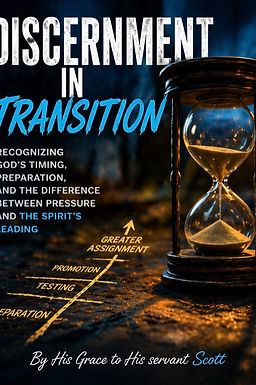
A mature servant leader must learn this early or learn it the hard way later: not every shift is God—some are escapes. Scripture says, “God is faithful… who will also make a way to escape” (1 Corinthians 10:13), but that escape is His, not ours. Many times, when pressure rises, relationships stretch, or discomfort increases, the flesh begins to look for relief instead of revelation. We can create exits that feel spiritual but are actually rooted in avoiding the very place God is using to form us. The question is not simply, “Is there a way out?” but, “Is this God’s way, or mine?” Because God’s leading produces alignment and growth, while self-made exits often abort the very development required for the next assignment.
God’s pattern is consistent—He prepares before He promotes. “He that is faithful in that which is least is faithful also in much” (Luke 16:10). David was anointed king but sent back to the field. Joseph was given a dream but walked through the pit and the prison before the palace. The mistake many leaders make is confusing what God revealed with what God has released. “Though the vision tarry, wait for it” (Habakkuk 2:3). Just because you can see something does not mean you are ready to carry it. And when leaders step into something prematurely, they often find themselves trying to sustain spiritually what was initiated in the flesh. That is where striving replaces abiding, and pressure replaces peace.
This is where discernment between pressure and the Holy Spirit becomes critical. The kingdom of God operates in “righteousness, and peace, and joy in the Holy Spirit” (Romans 14:17). Pressure driven by the flesh feels urgent, reactive, and emotionally charged—it says, “I have to move now.” But the Holy Spirit leads with clarity and peace, even when the direction is difficult. He does not drive you with panic; He draws you with purpose. “For as many as are led by the Spirit of God, they are the sons of God” (Romans 8:14). There is a difference between being pushed out by discomfort and being pulled forward by God. One produces instability; the other produces alignment.
Relational conflict is often the testing ground where this discernment is refined. “Iron sharpeneth iron” (Proverbs 27:17), and “tribulation worketh patience” (Romans 5:3). Not every difficult environment is a signal to leave—many are assignments designed to expose what is still unformed within us. If a servant leader runs every time tension arises, they will continually miss the deeper work of God. The flesh interprets discomfort as danger, but the Spirit often uses discomfort as development. Learning to stay when it’s hard is just as spiritual as knowing when to go.
The key is discerning the grace on the moment. Paul heard the Lord say, “My grace is sufficient for thee: for My strength is made perfect in weakness” (2 Corinthians 12:9). Grace is not just empowerment to move—it is also empowerment to remain. When grace is present, even in difficulty, there is still life, still conviction, still a sense that God is working. But when grace lifts, there is a consistent check in the spirit, a loss of clarity, and often external confirmations begin to align toward transition. The danger is leaving while grace is still present or staying when grace has already lifted. Both require discernment that only comes through closeness with God.
For major transitions, God often confirms His direction. “In the mouth of two or three witnesses shall every word be established” (2 Corinthians 13:1). He confirms through His Word, through the inner witness of peace, and through external alignment. This guards the servant leader from making life-altering decisions based on temporary emotion. Many have stepped too early into what was meant to be, only to find themselves overwhelmed because they entered without the necessary formation. Abraham produced Ishmael by moving ahead of God (Genesis 16), and Saul lost his place by forcing what God had not yet released (1 Samuel 13). The lesson is clear: what you force, you will have to sustain.
Maturity in servant leadership is learning to stay until God moves you and move the moment He says go. “Be still, and know that I am God” (Psalm 46:10). “They that wait upon the Lord shall renew their strength” (Isaiah 40:31). Waiting is not inactivity—it is alignment. It is the refusal to let pressure dictate direction. It is trusting that God’s timing is not only perfect, but protective. Because when He moves you, He also supplies the grace to carry what comes next.
At the center of all discernment is abiding. “Abide in Me, and I in you… for without Me you can do nothing” (John 15:4–5). Discernment is not a formula—it is a relationship. The closer you are to His voice, the clearer His timing becomes. You begin to recognize the difference between urgency and unction, between pressure and peace, between escape and assignment. And when that clarity comes, a true servant leader does not hesitate. He does not move early, and he does not delay. He walks in step with the Spirit.
Because at the end of the day, it’s not about getting there fast—it’s about getting there right.
Recent Devotionals

Discernimiento En Transición
Reconocer Los Tiempos De Dios, La Preparación Y La Diferencia Entre La Presión Y La Guía Del Espíritu.
Un líder servidor maduro debe aprender esto pronto o aprenderlo más adelante por las malas: no todo cambio de rumbo viene de Dios; algunos son escapatorias. La Escritura dice: «Dios es fiel… y también dará juntamente con la tentación la salida» (1 Corintios 10:13), pero esa salida es Suya, no nuestra. Muchas veces, cuando aumenta la presión, se tensan las relaciones o crece la incomodidad, la carne empieza a buscar alivio en vez de revelación. Podemos abrir puertas de salida que parecen espirituales, pero que en realidad nacen del deseo de evitar precisamente el lugar que Dios está usando para formarnos. La pregunta no es simplemente: «¿Hay una salida?», sino: «¿Es esta la salida que Dios ofrece o la que yo mismo busco?». Porque la dirección de Dios produce alineación y crecimiento, mientras que las salidas que uno mismo se procura suelen truncar el desarrollo necesario para la próxima misión.
El patrón de Dios es constante: Él prepara antes de promover.
Aquí es donde resulta fundamental discernir entre la presión y el Espíritu Santo. El reino de Dios opera en
Los conflictos en las relaciones suelen ser el campo de prueba donde se afina este discernimiento.
La clave está en discernir la gracia presente en ese momento. Pablo oyó al Señor decir:
En las transiciones importantes, Dios suele confirmar Su dirección.
La madurez en el liderazgo servidor consiste en aprender a quedarse hasta que Dios te mueva y a partir en el instante en que te diga que vayas.
En el centro de todo discernimiento está permanecer en Él.
Porque, al fin y al cabo, no se trata de llegar rápido, sino de llegar bien.
转型期的明辨能力
分辨神的时机与预备,以及压力和圣灵引导之间的区别
成熟的仆人领袖必须尽早明白这一点,否则日后就得付出沉重代价:并非每一次变动都出于神,有些只是逃避。经上说:“神是信实的……必给你们开一条出路”(哥林多前书 10:13),但那条出路是祂开辟的,不是我们自己开的。很多时候,当压力增大、人际关系紧张或不适感加剧时,肉体开始寻求解脱,而不是启示。我们可能会自行寻找退路,看似属灵,实际上却是为了逃离神正在用来塑造我们的处境。问题不只是“有没有出路?”,而是“这是神的道路,还是我自己的道路?”因为神的引领会带来对齐与成长,而人凭己意寻找的退路,往往会中断我们为承担下一项托付所必需的成长。
神一贯的法则是——先预备,再提升。
这正是分辨压力与圣灵引导的关键所在。神的国运行在
人际冲突往往是磨炼这种分辨力的试炼场。
关键在于分辨当下所承载的恩典。保罗听见主说:
面对重大的转变,神常常会印证祂的带领。
仆人领袖的成熟,体现在学会留守,直到神带领你离开;也在祂说“去”的那一刻立刻行动。
一切分辨的核心,都是住在主里面。
因为说到底,重要的不是尽快抵达,而是以正确的方式抵达。