February 23, 2026
Better He Kill Me Than I Become Him
The Hidden Victory of Servant Leadership Is Guarding the Heart When You Have Every Reason to Strike Back
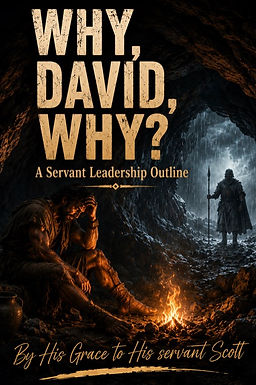
"But David said to his men, 'Far be it from me because of the Lord that I should do this thing to my lord, the Lord's anointed, to reach out with my hand against him, since he is the Lord's anointed.'" 1 Samuel 24:6
There are moments in every servant leader's life when God allows a test that reveals far more than our abilities. These moments uncover the true condition of our hearts. They expose whether we have merely learned to lead or whether we have truly learned to follow Christ. Such a moment came in David's life when King Saul unknowingly entered the very cave where David and his weary followers were hiding. For years Saul had pursued David with relentless hatred. He had slandered him, hunted him, and repeatedly attempted to kill him. Now, at last, David held every advantage. One thrust of a spear could end years of suffering. Every voice around him insisted that this was God's opportunity. Every human argument sounded reasonable. Yet heaven was asking a far deeper question than whether Saul would live or die. Heaven was asking what kind of man David would become.
Those gathered around David could not understand his decision. They saw injustice that deserved correction. They saw a kingdom waiting to be reclaimed. They saw freedom lying only one decision away. "Why, David?" surely echoed throughout the cave. Why continue running? Why continue suffering? Why not finally end the misery? Their reasoning sounded practical, courageous, and even spiritual. Yet David saw something they did not. He understood that the greatest danger standing in the cave was not Saul. The greatest danger was allowing Saul's spirit to enter his own heart.
Every servant leader eventually discovers that opposition has the power to shape us. We naturally assume our greatest battle is against difficult people, unfair circumstances, or hostile critics. In reality, our greatest battle is often against the temptation to become like those who wound us. Bitterness has a remarkable ability to disguise itself as righteousness. Revenge often dresses itself in the language of justice. Pride quietly convinces us that our retaliation is simply defending truth. Yet beneath these outward arguments lies a deeper question: What is happening to my heart?
David answered that question before he ever answered his men. He declared, "Far be it from me because of the Lord." 1 Samuel 24:6. Those words reveal that David's highest concern was never preserving Saul's throne. His concern was preserving his own relationship with God. David understood that one sinful act, even against a wicked king, could begin shaping him into the very kind of leader he despised. A throne gained through revenge would produce another Saul. A throne received through obedience could produce a shepherd king.
This principle reaches far beyond David's cave. Every servant leader will eventually have opportunities to justify revenge. Someone will misrepresent your motives. Someone will betray your trust. Someone may oppose your calling or attempt to destroy your reputation. In those moments, the flesh whispers that retaliation is strength. Scripture teaches otherwise. Paul writes, "Never take your own revenge, beloved, but leave room for the wrath of God, for it is written: 'Vengeance is Mine, I will repay,' says the Lord." Romans 12:19. Trusting God's justice requires greater faith than executing our own.
One of the greatest tragedies in leadership is that wounded people often become wounding leaders. Those who have been controlled sometimes become controlling. Those who have been rejected sometimes become rejecting. Those who have been criticized often become harsh critics themselves. Pain that is not surrendered to Christ frequently reproduces itself in the lives of others. David refused that cycle. He chose to let God's grace interrupt it. Rather than allowing Saul's hatred to define his future leadership, he allowed God's presence to transform his heart.
Jesus Christ perfectly fulfilled what David only foreshadowed. No one has ever endured greater injustice. He was betrayed by a disciple, abandoned by His closest friends, falsely accused, mocked, beaten, and crucified despite living a completely sinless life. Yet Peter writes, "While being reviled, He did not revile in return; while suffering, He uttered no threats, but kept entrusting Himself to Him who judges righteously." 1 Peter 2:23. Jesus possessed every right to judge His enemies immediately, yet He chose mercy instead. His authority remained perfectly submitted to the Father's will. That is the highest picture of servant leadership the world has ever seen.
The hidden work of brokenness teaches us that character is far more valuable than comfort. God was never merely preparing David to sit upon Israel's throne. He was preparing David to carry authority without allowing authority to corrupt him. Every cave, every lonely night, every unjust accusation, and every opportunity to retaliate became another lesson in God's school of leadership. The cave was not delaying David's destiny; it was protecting it. Until a leader learns to govern his own heart, he cannot be trusted to shepherd the hearts of others.
Servant leaders today face the same invitation. We may never stand over a sleeping king with a spear in our hands, but we regularly hold other kinds of weapons. Sharp words, hidden resentment, public criticism, social influence, and subtle retaliation can all become modern spears. The question remains unchanged. Will we throw them back? Or will we entrust ourselves to the God who judges righteously?
Perhaps the greatest victory in David's cave was not that Saul's life was spared. The greatest victory was that David's heart remained free. He refused to allow another man's sin to dictate his own obedience. He chose holiness over revenge, trust over control, surrender over ambition, and God's timing over human opportunity. That is why David eventually became a king after God's own heart. He understood that the greatest victories are often the invisible ones won deep within the soul.
As servant leaders, we must ask ourselves a difficult question. Am I more concerned about defeating those who oppose me, or about remaining faithful to the One who called me? Titles, influence, and success are temporary. Character is eternal. Better to lose an opportunity than lose a tender heart. Better to wait upon God's timing than seize His promises through fleshly methods. Better to suffer for a season than to become the very person whose actions once wounded us.
The Lord is still searching for leaders He can trust with influence. Not merely gifted leaders. Not merely successful leaders. But broken leaders whose hearts remain soft, whose hands remain clean, and whose lives reflect the character of Christ even when every earthly reason says otherwise.
"Do not be overcome by evil, but overcome evil with good." Romans 12:21
