November 8, 2026
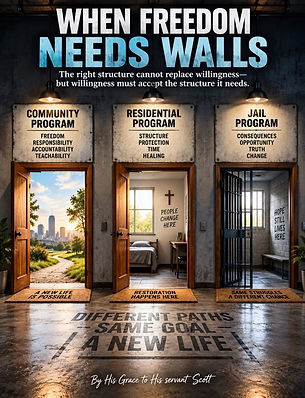
When Freedom Needs Walls
The Right Structure Cannot Replace Willingness—but Willingness Must Accept the Structure It Needs

Not everyone struggling with alcohol and drug addiction needs the same recovery environment. Some people can remain in the community and work a strong program while maintaining employment, family responsibilities, meetings, mentoring, Quiet Time, and daily accountability. Others have progressed so deeply into chronic addiction that the freedom around them has become dangerous. They need a residential facility where access is restricted, schedules are established, and someone else temporarily provides the boundaries they have repeatedly been unable to maintain. Still others begin recovery in jail or prison, where those boundaries have been imposed upon them. These environments are very different, but one truth runs through all three: lasting recovery requires willingness. Jesus said, “If anyone wants to come after Me, he must deny himself, take up his cross daily, and follow Me” (Luke 9:23). Recovery begins when “I want what I want” starts surrendering to “God, what do You want?”
When someone is working recovery while living in freedom, he may actually need greater intentional discipline because nobody is locking the door behind him. He can skip the meeting, ignore his mentor, avoid his inventory, call the old friend, drive to the old neighborhood, or return to the same environment where his addiction flourished. Freedom demands responsibility. If the walls are not holding you, willingness must help hold you. You must voluntarily build boundaries around your life and become teachable enough to listen when someone sees danger you cannot yet see. “Where there is no guidance the people fall, but in an abundance of counselors there is victory” (Proverbs 11:14). Submission begins with God, but genuine submission to God will make us willing to receive correction and direction from healthy people He places around us.
There comes a point, however, when addiction can become so chronic and out of control that good intentions are no longer sufficient. You may sincerely mean it when you say, “I’m never using again,” yet be using again twenty-four hours later. That does not necessarily mean there is no desire for change. It may mean your present environment provides more freedom than you are presently capable of handling. “All things are permitted for me, but I will not be mastered by anything” (1 Corinthians 6:12). When alcohol, cocaine, methamphetamine, opioids, marijuana, pills, or another substance repeatedly masters your decisions, you may need someone else to establish boundaries until you learn to establish them yourself. Residential treatment can remove access, interrupt destructive patterns, establish routine, and give the mind and body time to stabilize. Accepting that level of structure is not weakness. Sometimes surrender sounds like, “I cannot safely manage this freedom right now.”
Jail creates another kind of structure. The doors are locked, movement is controlled, and many choices are removed. But incarceration proves something important: external control is not the same thing as internal transformation. A man can spend months without his drug of choice simply because he cannot obtain it and walk out with the same thinking that brought him in. A locked door can interrupt behavior, but it cannot surrender the heart. God wants more than temporary abstinence. “And do not be conformed to this world, but be transformed by the renewing of your mind” (Romans 12:2). Whether recovery begins in jail, a residential facility, or while living at home, eventually the question becomes the same: What will I do when nobody is making me do it?
This is why choosing a recovery program cannot be based only upon convenience. Addiction negotiates: Do I really need residential treatment? Do I have to stay that long? Can I keep these friends? Can I work this my way? But wisdom asks a different question: What level of structure does my present condition require? “The way of a fool is right in his own eyes, but a person who listens to advice is wise” (Proverbs 12:15). The farther addiction has taken away our ability to govern ourselves, the more outside structure we may temporarily need.
Yet even the strongest facility cannot manufacture willingness. You can resist inside a treatment center just as easily as you can resist outside one. You can sit in a jail recovery class with your body present and your heart somewhere else. Eventually imposed structure must become chosen structure. Rules must become principles. Accountability must become daily inventory. Forced separation from drugs must become personal abstinence. Someone waking you for Quiet Time must eventually become you getting up because meeting with God has become necessary to your life.
“Submit therefore to God. But resist the devil, and he will flee from you” (James 4:7). That is the heart of recovery. The question is not simply, “Which program will fix me?” The question is, “Am I willing to do whatever is necessary to let God change me?” Community recovery, residential recovery, and correctional recovery provide different levels of structure, but none replaces surrender. The goal is not merely getting outside the walls. The goal is becoming the person who no longer needs walls to keep him from destroying himself. Real freedom is when the boundary that once had to be built around you has now been built by God within you.
By His Grace to His servant Scott.
Recent Devotionals
Cuando La Libertad Necesita Muros
La estructura correcta no puede reemplazar la disposición, pero la disposición debe aceptar la estructura que necesita
No todas las personas que luchan contra la adicción al alcohol y las drogas necesitan el mismo ambiente de recuperación. Algunas pueden permanecer en la comunidad y trabajar un programa sólido mientras mantienen su empleo, responsabilidades familiares, reuniones, mentoría, Tiempo a Solas con Dios e inventario diario. Otras han avanzado tan profundamente en una adicción crónica y fuera de control que la libertad que las rodea se ha vuelto peligrosa. Necesitan ingresar a un programa residencial donde el acceso al alcohol y las drogas esté restringido, existan horarios establecidos y otras personas proporcionen temporalmente los límites que ellas repetidamente no han podido mantener por sí mismas. Otras comienzan su recuperación en la cárcel o prisión, donde esos límites ya les han sido impuestos. Estos tres ambientes son diferentes, pero una verdad atraviesa los tres: la recuperación duradera requiere disposición y rendición. Jesús dijo: “Si alguien quiere venir en pos de Mí, niéguese a sí mismo, tome su cruz cada día y sígame” (Lucas 9:23). La recuperación comienza cuando “yo quiero lo que quiero” empieza a rendirse ante “Dios, ¿qué quieres Tú?”
Cuando alguien trabaja su recuperación mientras vive en libertad, puede necesitar aún mayor disciplina intencional porque nadie está cerrando la puerta detrás de él. Puede faltar a la reunión, ignorar a su mentor, evitar su inventario diario, llamar al viejo amigo o regresar al ambiente donde prosperó su adicción. La libertad exige responsabilidad. Si los muros no te están sosteniendo, tu disposición debe convertirse en parte de la estructura que te sostiene. Debes construir voluntariamente límites alrededor de tu vida y ser suficientemente enseñable para escuchar cuando alguien ve un peligro que tú todavía no puedes ver. “Donde no hay buen consejo, el pueblo cae, pero en la abundancia de consejeros está la victoria” (Proverbios 11:14). La sumisión comienza con Dios, pero la verdadera sumisión a Dios también nos hace estar dispuestos a recibir corrección y dirección de las personas sanas y maduras que Él coloca a nuestro alrededor.
Sin embargo, llega un momento cuando la adicción puede volverse tan crónica y estar tan fuera de control que las buenas intenciones ya no son suficientes. Puedes hablar sinceramente cuando dices: “Nunca volveré a consumir”, y veinticuatro horas después estar consumiendo otra vez. Eso no significa necesariamente que no deseas cambiar. Puede significar que tu ambiente actual te proporciona más libertad de la que actualmente puedes manejar de manera segura. “Todas las cosas me son lícitas, pero yo no me dejaré dominar por ninguna” (1 Corintios 6:12). Cuando el alcohol, la cocaína, la metanfetamina, los opioides, la marihuana, las pastillas u otra sustancia domina repetidamente tus decisiones, quizás necesites que otras personas establezcan límites hasta que aprendas a establecerlos tú mismo. El tratamiento residencial puede eliminar el acceso, interrumpir patrones destructivos, establecer una rutina y darle tiempo a la mente y al cuerpo para estabilizarse. Aceptar ese nivel de estructura no es debilidad. Algunas veces la verdadera rendición simplemente dice: “Ahora mismo no puedo manejar esta libertad de manera segura.”
La cárcel proporciona otro tipo de estructura. Las puertas están cerradas, el movimiento está controlado y muchas decisiones han sido eliminadas. Pero el encarcelamiento demuestra algo extremadamente importante: el control externo no es lo mismo que la transformación interna. Un hombre puede pasar meses sin consumir su droga simplemente porque no puede conseguirla y después salir de la cárcel con la misma manera de pensar que originalmente lo llevó allí. Una puerta cerrada puede interrumpir una conducta, pero no puede rendir el corazón. Dios quiere mucho más que una abstinencia temporal. “Y no se adapten a este mundo, sino transfórmense mediante la renovación de su mente” (Romanos 12:2). Ya sea que la recuperación comience en la cárcel, en un programa residencial o mientras vivimos en nuestra propia casa, finalmente todos enfrentamos la misma pregunta: ¿Qué haré cuando nadie me esté obligando a hacerlo?
Por eso un programa de recuperación no debe escogerse solamente por conveniencia. La adicción siempre quiere negociar: ¿Realmente necesito tratamiento residencial? ¿De verdad tengo que quedarme tanto tiempo? ¿Puedo conservar estas amistades? ¿Puedo seguir yendo a esos lugares? ¿Puedo trabajar este programa a mi manera? Pero la sabiduría hace una pregunta completamente diferente: ¿Qué nivel de estructura requiere realmente mi condición actual? “El camino del necio es recto a sus propios ojos, pero el que escucha consejos es sabio” (Proverbios 12:15). Mientras más nos haya quitado la adicción nuestra capacidad de gobernarnos a nosotros mismos, mayor estructura externa podremos necesitar temporalmente.
Sin embargo, aun la instalación más estructurada y el mejor programa de recuperación no pueden fabricar disposición. Puedes resistirte dentro de un centro de tratamiento igual que puedes resistirte fuera de él. Puedes sentarte en una clase de recuperación en la cárcel con tu cuerpo presente mientras tu corazón está en otro lugar. Finalmente, la estructura impuesta debe convertirse en estructura escogida. Las reglas deben convertirse en principios. La rendición de cuentas debe convertirse en inventario diario. La separación forzada del alcohol y las drogas debe convertirse en abstinencia personal. Que alguien te despierte para tu Tiempo a Solas con Dios debe finalmente convertirse en que tú mismo te levantes porque encontrarte con Dios se ha vuelto indispensable para tu vida.
“Sométanse, pues, a Dios. Resistan al diablo, y él huirá de ustedes” (Santiago 4:7). Ese es el corazón de la recuperación. La verdadera pregunta no es simplemente: “¿Qué programa puede arreglarme?” La verdadera pregunta es: “¿Estoy dispuesto a hacer todo lo que sea necesario para permitir que Dios me cambie?” La recuperación dentro de la comunidad, la recuperación residencial y la recuperación dentro de una cárcel proporcionan diferentes niveles de estructura, pero ninguna puede reemplazar la rendición. La meta no es simplemente salir de detrás de los muros. La meta es convertirte en una persona que ya no necesita muros para evitar destruirse a sí misma. La verdadera libertad llega cuando los límites que antes tuvieron que ser construidos alrededor de ti ahora han sido construidos por Dios dentro de ti.
Por Su Gracia a Su siervo Scott.
当自由需要围墙
正确的约束无法取代甘心顺服——但真正愿意改变的人,必须接受自己所需要的约束
并不是每一个与酒精和毒品成瘾争战的人,都需要相同的康复环境。有些人可以继续生活在社会中,同时认真执行康复计划,维持工作、家庭责任、参加聚会、接受导师带领、每天安静亲近神,并进行每日自我省察。然而,有些人的成瘾已经发展到严重、长期并失控的程度,以至于身边的自由反而成为危险。他们需要进入住宿式康复机构,在那里接触酒精和毒品的机会受到限制,生活有固定的作息,并由别人暂时帮助他们建立那些自己一次又一次无法守住的界限。还有一些人的康复是在监狱里开始的,那里的界限已经被强制加在他们身上。这三种环境虽然不同,却贯穿着同一个真理:持久的康复需要一颗甘心顺服的心。耶稣说:“若有人要跟从我,就当舍己,天天背起他的十字架来跟从我。”(路加福音9:23)康复真正开始于“我要我想要的”开始向“神啊,你要我做什么?”降服的时候。
当一个人在自由的社会环境中进行康复时,他实际上可能需要更强的自律,因为没有人在他身后把门锁上。他可以不去参加聚会,可以不听导师的话,可以逃避每日省察,可以重新联系过去的朋友,也可以回到曾经滋养他成瘾生活的环境。自由要求责任。如果没有围墙拦住你,那么你的甘心顺服就必须成为保护你的界限。你必须主动在自己的生活周围建立界限,并且拥有一颗受教的心;当别人看见你还没有看见的危险时,你愿意听进去。“无智谋,民就败落;谋士多,人便安居。”(箴言11:14)顺服从神开始,但真正顺服神的人,也会愿意接受神放在我们身边那些健康、成熟之人的纠正和带领。
然而,成瘾有时会发展到长期而严重失控的程度,以至于单靠良好的意愿已经不够。你可能真心地说:“我再也不会用了。”可是二十四小时之后,你却再次使用。这并不一定表示你根本不想改变;它可能意味着,你目前所处的环境给你的自由,已经超过了你现在能够安全管理的程度。“凡事我都可行,但我总不受任何事的辖制。”(哥林多前书6:12)当酒精、可卡因、冰毒、阿片类毒品、大麻、药片或其他物质不断控制你的决定时,你可能需要别人替你设立界限,直到你学会自己建立界限。住宿式康复可以切断接触渠道,中断毁灭性的生活模式,建立规律,并给身体和思想足够的时间稳定下来。接受这种程度的约束并不是软弱。有时候,真正的降服就是承认:“现在的我,还无法安全地管理这样的自由。”
监狱提供的是另一种约束。门被锁上,行动受到控制,许多选择也被拿走了。然而,监禁让我们看见一个非常重要的事实:**外在控制并不等于内在改变。**一个人可能几个月没有碰自己的成瘾物质,只因为他无法得到它;可是当他走出监狱时,他仍然可能带着当初把他带进监狱的同一种思维方式。锁上的门可以暂时中断行为,却不能使人的心降服。神所要的远远超过暂时的戒断。“不要效法这个世界,只要心意更新而变化。”(罗马书12:2)无论康复是在监狱、住宿式康复机构,还是在自己的家中开始,最终每个人都必须面对同一个问题:当没有人强迫我的时候,我会怎样选择?
因此,选择康复计划不能只考虑哪一个最方便。成瘾总喜欢讨价还价:我真的需要进入住宿式康复吗?真的需要待那么久吗?我还能不能继续和这些朋友来往?我能不能按照自己的方式来?但智慧提出的是另一个问题:按照我现在的情况,我究竟需要什么程度的约束?“愚妄人所行的,在自己眼中看为正直;惟智慧人肯听人的劝教。”(箴言12:15)成瘾越是夺走我们管理自己的能力,我们暂时所需要的外在约束可能就越多。
然而,即使最严格、最完善的康复机构,也无法制造一颗甘心改变的心。你在康复中心里面可以抗拒,就像你在外面一样可以抗拒。你可以坐在监狱的康复课堂里,身体在那里,心却完全在别处。最终,**被迫接受的约束必须转变为自己选择的约束。**规章必须成为原则;外在监督必须成为每日自我省察;被迫与毒品隔离必须成为自己选择的完全戒断;别人叫你起床安静亲近神,最终必须变成你自己主动起床,因为与神相遇已经成为你生命中不可缺少的一部分。
“故此,你们要顺服神。务要抵挡魔鬼,魔鬼就必离开你们逃跑了。”(雅各书4:7)这就是康复的核心。真正的问题并不只是:“哪一个康复计划能够修好我?”真正的问题是:**“我是否愿意付上一切必要的代价,让神改变我?”**社会中的康复、住宿式康复和监狱中的康复提供不同程度的外在结构,但没有任何一种结构能够代替降服。最终的目标并不仅仅是走出围墙。真正的目标,是成为一个不再需要围墙来阻止自己毁灭自己的人。真正的自由,就是过去必须建立在你周围的界限,如今已经被神建立在你的里面。
因祂的恩典,献给祂的仆人 Scott