October 31
The Substitute Snare
Playing With Another Sin Can Lead You Back to the One That Nearly Destroyed You
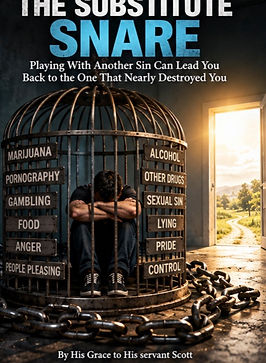
One of the most dangerous questions a recovering addict can ask is, “What can I still get away with?” We know alcohol nearly destroyed us, so we stay away from alcohol but begin negotiating with marijuana. We know drugs brought us into bondage, so we avoid our drug of choice while entertaining pornography, sexual sin, gambling, dishonesty, unhealthy relationships, or some other form of escape. We tell ourselves, “At least I’m not using.” But recovery was never supposed to become an experiment in discovering which chains we can safely wear. God did not rescue us from one form of slavery so we could negotiate with another. Scripture says, “Let’s also lay aside every encumbrance and the sin which so easily entangles us” (Hebrews 12:1). Sin entangles. It wraps itself around us one strand at a time.
Your drug of choice may have been the sin that finally brought you to your knees, but the bottle, pipe, pill, needle, or joint was often part of something much larger happening within the heart. Addiction trained us in secrecy, rationalization, immediate gratification, escape, dishonesty, isolation, entitlement, and self-will. We learned to say, “I need this. I deserve this. Nobody will know. Just this once. I can handle it.” When we begin entertaining another area of sin, those old attitudes start waking up again. The behavior may be different, but suddenly we are speaking the old language. We may be driving a different vehicle, but we are getting back onto the same highway.
That is why substitution is so deceptive. A person can stop drinking and become consumed with something else. Another can quit cocaine while beginning to use marijuana because “marijuana was never my problem.” Someone else stays completely drug-free but becomes enslaved to pornography or an unhealthy relationship. These behaviors are not identical, and their consequences are not always identical, but bondage has a common characteristic: something begins mastering me that God never intended to master me. Paul said, “All things are permitted for me, but I will not be mastered by anything” (1 Corinthians 6:12). Recovery must ask more than, “Is this as bad as what I used to do?” We must ask, “Is this beginning to own part of me?”
Sin always promises boundaries it eventually wants to cross. It says, “We will only go this far.” But once compromise becomes comfortable, yesterday’s boundary becomes today’s starting point. James explains the progression: “Each one is tempted when he is carried away and enticed by his own lust. Then when lust has conceived, it gives birth to sin; and sin, when it has run its course, brings forth death” (James 1:14–15). Nobody planning a relapse wakes up wanting another bottom. It usually begins much earlier—with permission. A little secrecy. A little compromise. A little justification. A little return to self-will.
Then comes the recovery statement that can hide enormous danger: “At least I’m not using.” Maybe you aren’t. Thank God for that. But if you are secretly feeding another bondage, don’t use yesterday’s destruction to justify today’s compromise. Being less enslaved is not the same as being free. Jesus said, “Everyone who commits sin is a slave of sin” (John 8:34). The goal of Christian recovery is not simply to keep the worst consequence from happening again. The goal is a surrendered life increasingly brought under the lordship of Jesus Christ.
For someone who has traveled deeply into addiction, returning to old patterns can be especially dangerous. You already know the road. Your mind remembers the rationalizations. Your body remembers intoxication. Your relationships remember the chaos. You may not have to travel slowly through every mile that originally took you downward. One compromise can begin reconnecting you with an entire way of living that God brought you out of. Scripture warns, “Like a dog that returns to its vomit, so is a fool who repeats his foolishness” (Proverbs 26:11). That is strong language because returning to bondage is serious business.
The answer is not living terrified of sin. The answer is living surrendered to God. “Submit therefore to God. But resist the devil, and he will flee from you. Come close to God and He will come close to you” (James 4:7–8). Notice the order. Submit. Resist. Draw near. Recovery becomes stronger when our attention shifts from merely avoiding the old drug toward developing a life that wants closeness with God more than compromise.
Eventually the question must change. Stop asking, “How much can I do without relapsing?” Stop asking, “How close can I get without crossing the line?” Start asking, “Does this strengthen my surrender? Does this keep my mind clear? Does this draw me toward Christ? Is this producing freedom or quietly rebuilding bondage?”
The enemy does not care which chain you wear. If he cannot immediately place the old chain around your neck, another one will do. And one form of bondage can eventually begin speaking the language of all the others. Jesus said, “So if the Son sets you free, you really will be free” (John 8:36). Recovery is not learning which chains are acceptable. It is learning to walk free—without negotiating with the very things Christ died to deliver us from.
By His Grace to His servant Scott.
Recent Devotionals

La Trampa De La Sustitución
Jugar con Otro Pecado Puede Llevarte de Regreso al que Casi te Destruyó
Una de las preguntas más peligrosas que puede hacer una persona en recuperación es: “¿Con qué puedo seguir saliéndome con la mía?” Sabemos que el alcohol casi nos destruyó, así que nos alejamos del alcohol, pero comenzamos a negociar con la marihuana. Sabemos que las drogas nos llevaron a la esclavitud, así que evitamos nuestra droga de preferencia mientras entretenemos la pornografía, el pecado sexual, los juegos de azar, la deshonestidad, relaciones dañinas o alguna otra forma de escape. Nos decimos: “Por lo menos no estoy consumiendo.” Pero la recuperación nunca tuvo como propósito convertirse en un experimento para descubrir qué cadenas podemos usar sin peligro. Dios no nos rescató de una forma de esclavitud para que pudiéramos negociar con otra. La Escritura dice: “Despojémonos también de todo peso y del pecado que tan fácilmente nos envuelve” (Hebreos 12:1). El pecado enreda. Se va envolviendo alrededor de nosotros, una hebra a la vez.
Tu droga de preferencia pudo haber sido el pecado que finalmente te llevó de rodillas, pero la botella, la pipa, la pastilla, la aguja o el cigarrillo de marihuana muchas veces formaban parte de algo mucho más grande que estaba ocurriendo dentro del corazón. La adicción nos entrenó en el secreto, la racionalización, la gratificación inmediata, el escape, la deshonestidad, el aislamiento, el sentirnos con derecho y la voluntad propia. Aprendimos a decir: “Necesito esto. Me lo merezco. Nadie lo sabrá. Solo esta vez. Yo puedo controlarlo.” Cuando comenzamos a entretener otra área de pecado, esas viejas actitudes empiezan a despertar nuevamente. La conducta puede ser diferente, pero de repente estamos hablando el viejo idioma. Tal vez conducimos un vehículo diferente, pero estamos regresando a la misma carretera.
Por eso la sustitución es tan engañosa. Una persona puede dejar de beber y quedar consumida por otra cosa. Otra puede dejar la cocaína mientras comienza a usar marihuana porque “la marihuana nunca fue mi problema”. Otra puede permanecer completamente libre de drogas, pero convertirse en esclava de la pornografía o de una relación dañina. Estas conductas no son idénticas, y sus consecuencias tampoco son siempre idénticas, pero la esclavitud tiene una característica común: algo comienza a dominarme que Dios nunca diseñó para dominarme. Pablo dijo: “Todas las cosas me son lícitas, pero yo no me dejaré dominar por ninguna” (1 Corintios 6:12). La recuperación debe preguntar más que: “¿Es esto tan malo como lo que hacía antes?” Debemos preguntar: “¿Está esto comenzando a poseer una parte de mí?”
El pecado siempre promete límites que finalmente quiere cruzar. Dice: “Solo llegaremos hasta aquí.” Pero cuando la concesión comienza a sentirse cómoda, el límite de ayer se convierte en el punto de partida de hoy. Santiago explica la progresión: “Cada uno es tentado cuando es llevado y seducido por su propia pasión. Después, cuando la pasión ha concebido, da a luz el pecado; y cuando el pecado es consumado, engendra la muerte” (Santiago 1:14–15). Nadie que se dirige hacia una recaída se despierta deseando tocar fondo otra vez. Generalmente comienza mucho antes: con permiso. Un poco de secreto. Una pequeña concesión. Una pequeña justificación. Un pequeño regreso a la voluntad propia.
Entonces aparece una frase de recuperación que puede esconder un enorme peligro: “Por lo menos no estoy consumiendo.” Tal vez no lo estás haciendo. Gracias a Dios por eso. Pero si secretamente estás alimentando otra esclavitud, no utilices la destrucción de ayer para justificar la concesión de hoy. Estar menos esclavizado no significa ser libre. Jesús dijo: “Todo el que comete pecado es esclavo del pecado” (Juan 8:34). La meta de la recuperación cristiana no es simplemente impedir que vuelva a suceder la peor consecuencia. La meta es una vida rendida que cada vez está más bajo el señorío de Jesucristo.
Para alguien que ha descendido profundamente en la adicción, regresar a los viejos patrones puede ser especialmente peligroso. Ya conoces el camino. Tu mente recuerda las racionalizaciones. Tu cuerpo recuerda la intoxicación. Tus relaciones recuerdan el caos. Tal vez no tengas que recorrer lentamente cada kilómetro que originalmente te llevó hacia abajo. Una sola concesión puede comenzar a reconectarte con toda una manera de vivir de la cual Dios te sacó. La Escritura advierte: “Como perro que vuelve a su vómito es el necio que repite su necedad” (Proverbios 26:11). Es un lenguaje fuerte porque regresar a la esclavitud es un asunto serio.
La respuesta no es vivir aterrorizados por el pecado. La respuesta es vivir rendidos a Dios. “Sométanse, pues, a Dios. Resistan al diablo, y él huirá de ustedes. Acérquense a Dios, y Él se acercará a ustedes” (Santiago 4:7–8). Observa el orden. Someterse. Resistir. Acercarse. La recuperación se fortalece cuando nuestra atención deja de enfocarse solamente en evitar la vieja droga y comienza a desarrollar una vida que desea la cercanía con Dios más que la concesión.
Finalmente, la pregunta tiene que cambiar. Deja de preguntar: “¿Cuánto puedo hacer sin recaer?” Deja de preguntar: “¿Qué tan cerca puedo llegar sin cruzar la línea?” Comienza a preguntar: “¿Fortalece esto mi rendición? ¿Mantiene clara mi mente? ¿Me acerca a Cristo? ¿Está produciendo libertad o está reconstruyendo silenciosamente una esclavitud?”
Al enemigo no le importa qué cadena lleves puesta. Si no puede colocarte inmediatamente la vieja cadena alrededor del cuello, otra le servirá. Y una forma de esclavitud eventualmente puede comenzar a hablar el idioma de todas las demás. Jesús dijo: “Así que, si el Hijo los hace libres, ustedes serán realmente libres” (Juan 8:36). La recuperación no consiste en aprender cuáles cadenas son aceptables. Consiste en aprender a caminar en libertad, sin negociar con aquellas mismas cosas de las cuales Cristo murió para liberarnos.
Por Su Gracia a Su siervo Scott.
替代的陷阱
玩弄另一种罪,可能把你带回那个差点毁掉你的罪
一个正在戒瘾康复的人所能问的最危险的问题之一就是:“我还有哪些事情可以做而不出问题?”我们知道酒精差点毁掉自己,于是远离酒精,却开始和大麻讨价还价。我们知道毒品曾经使我们进入捆绑,于是避开自己的首选毒品,却开始容让色情、性方面的罪、赌博、不诚实、不健康的关系,或者其他形式的逃避。我们对自己说:“至少我没有再吸毒。”然而,康复从来不是一场实验,让我们去寻找哪些锁链戴在身上仍然是“安全的”。神没有把我们从一种奴役中拯救出来,好让我们再去和另一种奴役讨价还价。圣经说:“就当放下各样的重担,脱去容易缠累我们的罪。”(希伯来书 12:1)罪会缠住人。它往往不是一下子把我们捆死,而是一根一根地缠绕在我们身上。
你的首选毒品可能是最终把你逼到跪下来的那个罪,但酒瓶、烟斗、药片、针头或大麻烟卷,往往只是内心更大问题的一部分。成瘾训练我们活在秘密、合理化、即时满足、逃避、不诚实、孤立、自我权利和任性之中。我们学会对自己说:“我需要这个。我值得拥有这个。没有人会知道。就这一次。我能控制。”当我们开始容让另一个领域的罪时,那些旧态度也开始重新苏醒。行为也许不同,但是我们突然又开始说过去成瘾时所说的语言。我们也许换了一辆车,但却重新开上了同一条公路。
这就是为什么“替代”如此具有欺骗性。一个人可以戒酒,却开始被另一件事情控制。另一个人可以戒掉可卡因,却开始使用大麻,因为他说:“大麻从来不是我的问题。”还有一个人可能完全不再碰毒品,却成为色情或不健康关系的奴隶。这些行为并不完全相同,它们造成的后果也不完全一样,但捆绑有一个共同特征:某样神从未设计来管理我的东西,开始管理我的生命。保罗说:“凡事我都可行,但我不受任何事的辖制。”(哥林多前书 6:12)康复不能只问:“这件事有没有我以前做的那么严重?”我们必须问:“这件事是不是已经开始占据我的一部分生命?”
罪总是承诺它不会越过某些界线,而最终它却想跨越所有界线。它说:“我们只到这里,不会再往前了。”但是一旦妥协变得舒服,昨天的界线就会成为今天的起点。雅各解释了这个过程:“各人被试探,乃是被自己的私欲牵引诱惑的。私欲既怀了胎,就生出罪来;罪既长成,就生出死来。”(雅各书 1:14–15)没有人计划复吸时会在早晨醒来想着:“我今天想再次跌到人生谷底。”复吸通常早在真正使用毒品以前就已经开始了——从给自己许可开始。一点秘密。一点妥协。一点合理化。一点点重新回到自我意志。
然后,我们会说出一句在康复中听起来很有道理、实际上却可能隐藏巨大危险的话:“至少我没有再吸毒。”也许你确实没有。为此感谢神。但是,如果你正在秘密喂养另一种捆绑,就不要利用昨天的毁灭来为今天的妥协辩护。被奴役得少一点,并不等于自由。耶稣说:“所有犯罪的就是罪的奴仆。”(约翰福音 8:34)基督徒康复的目标,不仅仅是避免过去最严重的后果再次发生。真正的目标是一颗降服的生命,越来越完全地活在耶稣基督的主权之下。
对于一个曾经深陷成瘾的人来说,重新回到旧有模式尤其危险。你已经认识那条路。你的思想记得那些合理化的借口。你的身体记得醉酒和吸毒的感觉。你的关系记得过去的混乱。你可能不需要再次慢慢走过当初堕落时所走的每一公里。一点妥协,就可能重新把你连接到神曾经带你离开的整套生活方式。圣经警告:“愚昧人行愚妄事,行了又行,就如狗转过来吃它所吐的。”(箴言 26:11)这是非常强烈的语言,因为重新回到捆绑是一件极其严重的事情。
答案不是活在对罪的恐惧之中。答案是活在对神的降服之中。“所以你们要顺服神。务要抵挡魔鬼,魔鬼就必离开你们逃跑了。你们亲近神,神就必亲近你们。”(雅各书 4:7–8)注意这个次序:顺服、抵挡、亲近。真正的康复会变得越来越坚固,因为我们的注意力不再只是放在“绝对不能再碰过去的毒品”上,而是开始建立一种渴望亲近神胜过渴望妥协的生命。
最终,我们的问题必须改变。不要再问:“我可以做到什么程度而不复吸?”不要再问:“我可以离那条界线多近而不跨过去?”开始问:“这会不会加强我对神的降服?这会不会让我保持清醒的思想?这会不会使我更亲近基督?这正在产生自由,还是正在悄悄地重新建造捆绑?”
仇敌并不在乎你戴的是哪一条锁链。如果它不能立刻把过去那条锁链重新套在你的脖子上,那么另一条锁链对它来说也完全可以。最终,一种捆绑会开始说出所有其他捆绑都熟悉的语言。耶稣说:“所以天父的儿子若叫你们自由,你们就真自由了。”(约翰福音 8:36)康复不是学习哪些锁链是可以接受的。康复是学习真正行走在自由中,不再与那些基督舍命要把我们从其中释放出来的东西讨价还价。
因祂的恩典,献给祂的仆人 Scott。