June 4, 2026
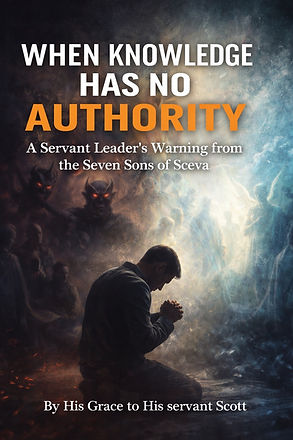
When Knowledge Has No Authority
A Servant Leader’s Warning from the Seven Sons of Sceva

There is a sobering reality every servant leader must come to grips with: spiritual authority does not come from what you know, but from Who you know and walk with. Acts 19:13–16 gives us one of the clearest and most unsettling examples in all of Scripture. The seven sons of Sceva attempted to cast out demons by saying, “We exorcise you by the Jesus whom Paul proclaims.” They had the language. They had the formula. They even used the right Name. But they did not have the relationship. And the response from the demonic realm exposed the truth: “Jesus I know, and Paul I recognize, but who are you?” (Acts 19:15). What followed was not victory, but defeat—public, humbling, and undeniable. This passage reveals something every servant leader must understand: borrowed language cannot replace personal authority, and secondhand revelation cannot produce firsthand power.
In servant leadership, there is always the temptation to operate from what we have learned instead of how we are living. We can quote Scripture, teach principles, and even mimic the patterns of anointed leaders, yet still lack the abiding presence of Christ in our own lives. The sons of Sceva were not ignorant of truth—they were disconnected from the Person of truth. Jesus said in John 14:6, “I am the way, the truth, and the life.” Truth is not merely something to be studied; it is Someone to be known. When truth becomes detached from relationship, it loses its authority in our lives. This is why Jesus warns in Matthew 7:22–23 that many will say, “Lord, Lord, did we not prophesy in Your name…?” and yet He will respond, “I never knew you.” The issue was never activity—it was intimacy.
A servant leader must understand that the Kingdom of God operates on relationship-based authority. Luke 10:19 speaks of authority over the enemy, but that authority is not a tool we wield independently—it flows from our connection to Christ. John 15:5 makes it unmistakably clear: “Apart from Me you can do nothing.” Not less. Nothing. The sons of Sceva tried to function apart from Him while using His Name, and the result was exposure. This is the danger in modern servant leadership—when we rely on accumulated knowledge, past experiences, or borrowed messages instead of present dependence on Jesus. We may sound right, but we will lack weight. We may speak truth, but it will not carry power.
There is also a deep warning here regarding identity. The demonic response—“Who are you?”—cuts to the core. Authority flows from identity, and identity is formed in relationship with Christ. Paul was recognized not because of his volume or activity, but because of his surrendered life. Galatians 2:20 reflects this reality: “It is no longer I who live, but Christ who lives in me.” This is where true authority is formed—not in public platforms, but in private surrender. A servant leader’s authority is not built in front of people; it is built before God. What is developed in the secret place is what stands in the open.
1 Corinthians 4:20 reminds us, “For the kingdom of God is not in word but in power.” That power is not emotional hype or intellectual persuasion—it is the manifested life of Christ flowing through a yielded vessel. Knowledge alone can inform the mind, but only intimacy transforms the life. This is why 2 Timothy 3:5 warns of having “a form of godliness but denying its power.” It is possible to look the part, speak the part, and even lead others, yet lack the inner reality that gives those things substance. A servant leader must refuse to settle for appearance and press into authenticity.
The call, then, is not to abandon truth, but to anchor it in relationship. Doctrine matters, but it must lead us into deeper communion with Christ, not replace it. Philippians 3:10 captures the heart of a true servant leader: “That I may know Him and the power of His resurrection.” This knowing is not intellectual—it is experiential, relational, ongoing. It is cultivated daily in the quiet place of prayer, surrender, and obedience. It is where identity is formed, authority is established, and discernment is sharpened.
At the end of the day, every servant leader must answer the same question that echoed in that moment: “Who are you?” Not based on titles, knowledge, or ministry activity, but based on relationship with Jesus Christ. Because in the Kingdom, it is not enough for us to know about Him—He must know us, and we must walk with Him. When that is established, authority follows. When that is missing, everything else becomes fragile. The sons of Sceva serve as a warning, but also an invitation—to move beyond borrowed faith into a living, abiding relationship with Christ, where truth is not just spoken, but embodied, and where the Name of Jesus is not just used, but carried with authority that comes from being truly His.