January 20, 2026
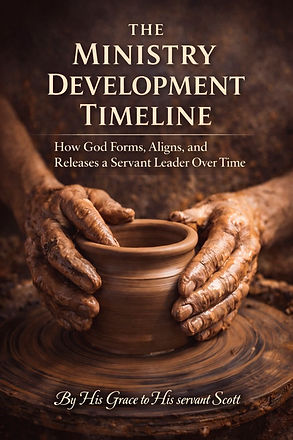
The Ministry Development Timeline
How God Forms, Aligns, and Releases a Servant Leader Over Time

A servant leader must understand that true ministry development is not driven by opportunity, urgency, or even visible need—it is governed by God’s timing and process of formation. What many call “stepping into ministry” is often only a small visible moment in a much longer hidden timeline where God has been shaping the leader long before anyone else could see it. Scripture reveals this pattern repeatedly, as Paul writes, “But when God, who set me apart from my mother’s womb and called me by His grace, was pleased to reveal His Son in me…” (Galatians 1:15–16). Notice the order—God reveals Christ in the servant before He reveals the servant to the world. This is the foundation of ministry development: inward formation precedes outward function.
This timeline is not linear in the natural sense, but it is intentional in the spiritual sense. God is not rushing to get a leader into position—He is preparing the leader to carry what that position requires. Many frustrations in leadership come from misunderstanding this. We tend to measure readiness by desire, gifting, or open doors, but God measures readiness by formation, alignment, and proven faithfulness. Proverbs 20:24 reminds us, “A person’s steps are directed by the Lord. How then can anyone understand their own way?” A servant leader must learn to trust that even the delays, the hidden seasons, and the limitations are not setbacks, but strategic parts of development.
At the core of this timeline is the priority of character formation. Before anything is built through a leader, something must be built within him. God establishes humility before authority, surrender before responsibility, and obedience before influence. This is why Jesus Himself, though fully God, walked through a process of development, as Luke 2:52 says, “And Jesus grew in wisdom and stature, and in favor with God and man.” If the Son of God did not bypass development, neither will those who follow Him in leadership. Character formation is where the leader learns to be governed by God rather than driven by self. It is where motives are purified and identity is anchored, so that when influence comes, it does not corrupt what God has formed.
As this foundation is laid, relational formation begins to take shape. Ministry is never developed in isolation, because God does not form leaders in a vacuum—He forms them in relationship. First, the vertical relationship with God deepens into real dependence, where the leader is no longer just seeking direction from God, but learning to abide in Him. Jesus said, “Remain in Me, as I also remain in you… apart from Me you can do nothing” (John 15:4–5). This becomes more than a verse—it becomes a leadership reality. The leader learns that effectiveness is not produced by effort, but by connection.
But just as critical is the horizontal formation that takes place through people. God uses relationships to expose what isolation can hide. Offenses reveal pride. Conflict reveals immaturity. Accountability reveals resistance. Close relationships reveal whether love is genuine or conditional. Proverbs 27:17 says, “As iron sharpens iron, so one person sharpens another.” This sharpening is not always comfortable, but it is necessary. A servant leader is shaped through correction, through misunderstanding, through serving under others, and through learning to walk in humility when misunderstood or overlooked.
Relational formation is also where God heals what would otherwise distort leadership. Many leaders carry wounds, insecurities, or unmet needs that, if left unaddressed, will eventually surface in how they lead others. God, in His mercy, allows relationships to press on those areas—not to break the leader, but to heal him. Ephesians 4:15 calls us to “speak the truth in love,” and it is in these environments that a leader learns how to receive truth without defensiveness and give truth without control. This is where emotional maturity and spiritual maturity begin to align.
In leadership development, relationships are not distractions from the call—they are part of the call. A leader is not only being prepared to handle responsibility, but to handle people. Love, patience, forgiveness, honor, and unity are not optional traits; they are essential leadership competencies in the Kingdom. Jesus said, “By this everyone will know that you are My disciples, if you love one another” (John 13:35). That means relational health becomes a visible evidence of internal formation. A leader who cannot walk in humility and honor with others will struggle to sustain anything God builds through him, no matter how strong his gifting may be.
From there, ministry formation begins to emerge—not as a platform to prove something, but as an opportunity to steward something. God starts entrusting assignments, often small and unseen, to test faithfulness and obedience. Luke 16:10 establishes this principle clearly: “Whoever can be trusted with very little can also be trusted with much.” In this phase, the leader is learning not just what to do, but how to do it with the right spirit. Ministry is no longer about activity—it becomes about alignment. The leader begins to understand that effectiveness in God’s Kingdom is not measured by how much is done, but by how closely it reflects God’s will.
As these areas mature, there comes a defining transition—a paradigm shift into discernment and Kingdom alignment. This is where the timeline begins to converge. What was once learned in parts now begins to function as a whole. The leader develops spiritual clarity, not just knowledge. Decisions are no longer driven by pressure, emotion, or opportunity alone, but by discernment. Hebrews 5:14 speaks of those “who by constant use have trained themselves to distinguish good from evil.” This is not just moral discernment, but leadership discernment—the ability to recognize what is from God, what is not, and what is simply not yet. Often, this stage is marked by a deep surrender—what you described as a “white funeral”—where personal ambition, reputation, and control are fully laid down. In this place, leadership becomes less about building something for God and more about being led by God.
Finally, the timeline moves into what can be called afterflow—where years of formation, alignment, and faithfulness begin to produce lasting fruit beyond direct effort. The leader is no longer striving to establish influence; influence flows naturally from a life that has been consistently yielded to God. This is where multiplication takes place. Paul instructs Timothy in 2 Timothy 2:2 to entrust truth to faithful people who will teach others also. The leader’s life becomes a resource, not just his words. His influence extends into people, systems, and future generations. What was once personal formation becomes corporate impact.
In the end, a servant leader must recognize that ministry development is not something to control, but something to cooperate with. It is God who forms, God who aligns, and God who releases. The responsibility of the servant leader is not to force advancement, but to remain faithful in each stage. Because when God develops a leader, He does it in such a way that the fruit is not temporary, the influence is not shallow, and the foundation does not fail. And in that process, the leader becomes not just someone who does ministry, but someone who has been shaped by God to carry it well over a lifetime.