June 11, 2026
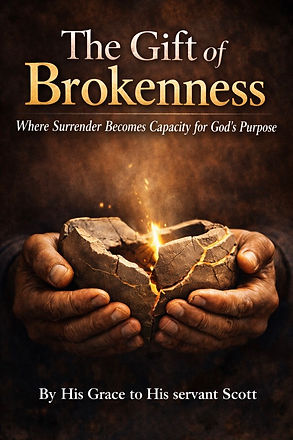
The Gift of Brokenness
Where Surrender Becomes Capacity for God’s Purpose

There comes a moment in the life of a servant leader that goes beyond the initial beauty of salvation—a moment not always spoken of, not always understood, but absolutely necessary. Salvation brings us into relationship with Christ, but it does not automatically bring us into full surrender to His purposes. Jesus made this clear when He said, “If any man will come after me, let him deny himself, and take up his cross daily, and follow me” (Luke 9:23). There is a deeper yielding, a defining “yes” where a person stands before the Lord and, to the best of their ability, abandons their rights, their plans, their identity, and their future into His hands. This is not emotional hype or spiritual language—it is a decisive act of the will. It is the moment where we move from simply receiving salvation to becoming a living sacrifice, as Romans 12:1 calls us: “present your bodies a living sacrifice, holy, acceptable unto God, which is your reasonable service.”
From that place of surrender, something profound begins—not instantly completed, but divinely initiated. God begins what can only be described as the gift of brokenness. This is not punishment, nor is it rejection. It is the loving, sovereign work of a Father preparing His vessel to carry what He has ordained. David understood this when he wrote, “The sacrifices of God are a broken spirit: a broken and a contrite heart, O God, thou wilt not despise” (Psalm 51:17). Brokenness is not something we manufacture; it is something God works into the depths of our being. And it does not remain in theory—it moves from head knowledge into lived reality.
This process is deeply personal and completely sovereign. No two servant leaders are broken the same way because no two callings require the same preparation. Hebrews 12:10–11 reminds us that God disciplines us “for our profit, that we might be partakers of His holiness,” and though it may not seem joyful in the moment, it yields “the peaceable fruit of righteousness.” For one, brokenness may come through failure that exposes hidden pride. For another, it may come through waiting that confronts control. For another, through obscurity that refines motives. God knows exactly what must be removed, what must be healed, and what must be surrendered so that Christ—not self—remains at the center.
As this breaking unfolds, it often brings tension. It can feel confusing, even painful, because it touches the very areas we once relied upon. This is why it is critical to return to that moment of surrender. When the process feels overwhelming, we anchor ourselves not in our emotions but in our decision: “Lord, I gave You everything.” Jesus gives us the picture in John 12:24: “Except a corn of wheat fall into the ground and die, it abideth alone: but if it die, it bringeth forth much fruit.” The fruit we desire is always on the other side of a death we did not fully understand when we first said yes.
The purpose of brokenness is not to weaken us—it is to create capacity. Without it, our gifting will outrun our character, and our calling will collapse under its own weight. Paul writes, “We have this treasure in earthen vessels, that the excellency of the power may be of God, and not of us” (2 Corinthians 4:7). Brokenness ensures that what God places within us is carried in a way that brings Him glory, not ourselves. It dismantles self-reliance and replaces it with dependence. It strips away the illusion of control and anchors us in abiding. As Jesus said in John 15:5, “without me ye can do nothing.”
This is where the paradox of the Kingdom becomes real. What the world sees as weakness, God declares as strength. Paul encountered this when the Lord told him, “My grace is sufficient for thee: for my strength is made perfect in weakness” (2 Corinthians 12:9). Brokenness becomes the place where grace flows freely, where dependence is no longer resisted but embraced, and where true authority is formed—not from striving, but from surrender.
Ultimately, brokenness is a gift because it allows us to hold what God gives without being destroyed by it. Many desire influence, impact, and purpose, but few understand the preparation required to sustain those things in a way that honors God. “Humble yourselves therefore under the mighty hand of God, that he may exalt you in due time” (1 Peter 5:6). The exaltation is His responsibility; the humility is ours. And humility is not merely a posture we choose once—it is a condition God forms in us through the ongoing work of brokenness.
For the servant leader, this does not become a one-time experience but a lifelong posture. We learn to live open-handed, yielded, and responsive to His voice. Isaiah 66:2 declares, “to this man will I look, even to him that is poor and of a contrite spirit, and trembleth at my word.” This is the leader God entrusts—one who has been broken, not to be diminished, but to be made usable in the hands of a holy God.
So we do not pursue brokenness itself—we pursue full surrender. And in His mercy, God gives us the gift of brokenness, shaping us into vessels that can carry His presence, His purpose, and His glory in a way that remains.