August 4, 2026
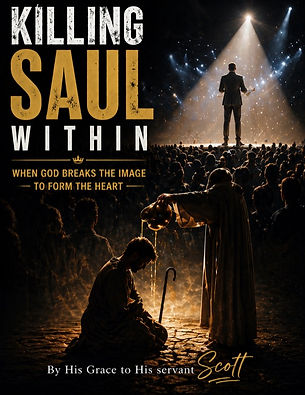
Killing Saul Within
When God Breaks the Image to Form the Heart

There is a sobering tension every servant leader must face if they are going to walk in truth and not illusion: the very thing people are drawn to in leadership is often the very thing God is trying to crucify. From the beginning, the people of God have shown a tendency to desire what looks strong, impressive, and outwardly qualified. In 1 Samuel 8:5–7, Israel cried out, “Give us a king… like all the nations,” rejecting God’s leadership for something visible, measurable, and culturally acceptable. And so Saul was chosen—a man who stood head and shoulders above the rest (1 Samuel 9:2), a man who looked the part. But what man celebrates externally, God examines internally. “Man looks at the outward appearance, but the Lord looks at the heart” (1 Samuel 16:7). This is where servant leadership begins—not in what is seen, but in what is surrendered.
Saul represents more than a historical king—he represents the flesh in leadership. He obeyed, but only partially. He sacrificed, but not in alignment with God’s command. “To obey is better than sacrifice” (1 Samuel 15:22). Yet Saul’s deeper issue was not disobedience alone—it was identity rooted in people’s approval. “I feared the people and obeyed their voice” (1 Samuel 15:24). That statement exposes the root. Saul was being led by the crowd while trying to appear led by God. And if we’re honest, that same pull exists in every servant leader. The desire to be accepted, affirmed, and seen as effective can slowly shift us from obedience to performance. We begin to protect image instead of surrendering heart. We begin to build what looks right instead of yielding to what God is forming. And without realizing it, Saul is still alive within.
But God, in His mercy, does not anoint what He has rejected. While Saul was still sitting on the throne, God had already moved on. In 1 Samuel 16, He sends Samuel to anoint a new king—not the obvious choice, not the one presented first, but the one hidden in the field. David was overlooked, unseen, and unqualified in the eyes of man, yet fully seen and chosen by God. Why? Because while Saul was formed by public affirmation, David was formed in private surrender. “The Lord has sought for Himself a man after His own heart” (1 Samuel 13:14). This is the distinction. God is not looking for outward readiness—He is looking for inward alignment. And servant leaders must understand this: what God chooses often contradicts what people would select.
So how does God deal with the Saul within us? Not through promotion, but through breaking. “Unless a grain of wheat falls into the ground and dies, it remains alone; but if it dies, it produces much grain” (John 12:24). The breaking seasons—misunderstanding, hiddenness, correction, even failure—are not God abandoning us; they are God forming us. He is removing the false identity that depends on appearance so that the true identity rooted in Christ can emerge. “We have this treasure in jars of clay, to show that the surpassing power belongs to God and not to us” (2 Corinthians 4:7). The vessel must be weak so the power can be clearly His. And this is where many leaders struggle. We want to be used, but we resist the process that makes us usable. We want the anointing, but we avoid the altar.
The challenge intensifies when we are called to lead people who still desire Saul. The crowd often equates anointing with charisma, depth with visibility, and calling with platform. But Paul confronts this tension directly: “Am I now seeking the approval of man, or of God?… If I were still trying to please man, I would not be a servant of Christ” (Galatians 1:10). Servant leadership requires the courage to remain faithful to God’s voice even when it does not align with people’s expectations. It requires the humility to be misunderstood, the restraint to not perform, and the discipline to stay rooted in abiding. “Apart from Me you can do nothing” (John 15:5). Not little—nothing. Which means everything that carries eternal weight must come from Him, not from our striving.
This is why the cross is central to servant leadership. “I have been crucified with Christ; it is no longer I who live, but Christ lives in me” (Galatians 2:20). This is not poetic language—it is the daily posture of a true servant leader. Saul must die so Christ can live. The need to be seen must die so His presence can be revealed. The drive to perform must die so His Spirit can lead. And as that happens, something powerful takes place—not manufactured fruit, but abiding fruit. “He who abides in Me… bears much fruit” (John 15:5). This is the difference between striving and surrender. One exhausts, the other multiplies.
So the question is not whether God can use you—the question is whether you are willing to let Him break what is false so He can reveal what is true. Because the oil does not flow on image—it flows on surrender. “A broken and contrite heart—these, O God, You will not despise” (Psalm 51:17). The crowd may still cry out for Saul, but heaven is searching for a heart that has been emptied of self and filled with Christ. And in that place, where the false king has died, true servant leadership is born—not formed by man, but formed by Him, and for Him.