May 15, 2026
God Provides In Unexpected Ways
A Servant Leader’s Call to Trust God Beyond Logic and Follow Him Into Provision

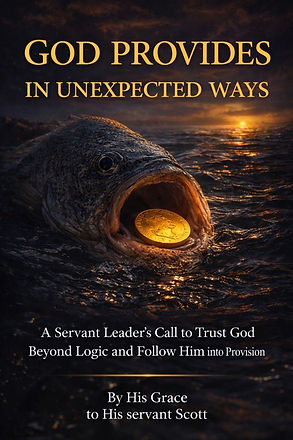
There is a defining tension every servant leader must face—the pull between trusting what makes sense and obeying what God says. In Matthew 17:27, Jesus tells Peter something that does not fit any logical framework of provision: “Go to the sea, cast in a hook, and take the fish that comes up first. And when you have opened its mouth, you will find a piece of money.” This moment is not just about a miracle—it is about formation. Jesus was not simply meeting a need; He was training a servant leader to live beyond natural reasoning and into divine dependence. Many leaders want provision, but few are willing to follow God into places where provision cannot be predicted, managed, or controlled.
Servant leadership is not sustained by systems—it is sustained by trust. Peter could have questioned the instruction. He could have analyzed the improbability of a coin being in a fish’s mouth. But servant leaders learn something critical: obedience is not rooted in understanding, it is rooted in relationship. Proverbs 3:5–6 calls us into this reality, “Trust in the Lord with all your heart, and lean not on your own understanding; in all your ways acknowledge Him, and He shall direct your paths.” Direction comes when understanding is surrendered. Many leaders stall because they wait for clarity before obedience, but God often withholds explanation so that trust can be formed.
What makes this moment even more powerful is that God chose something ordinary to carry something supernatural. A fish—common, overlooked, part of Peter’s daily life—became the vessel of provision. This reveals a pattern that servant leaders must recognize: God often hides His provision in the ordinary rhythms of obedience. Zechariah 4:10 warns us not to “despise the day of small things,” yet many leaders are looking for dramatic moves of God while missing Him in the simple. A phone call, a conversation, a step of obedience, a moment of restraint—these are often the places where God has already prepared provision. The issue is not that God is not providing; the issue is that we are not recognizing how He chooses to provide.
There is also a deeper layer here—provision is not just practical, it is personal. The coin in the fish’s mouth was not random; it was precise. It covered both Jesus and Peter. This was not just about meeting a financial need; it was about revealing the nature of God as one who sees, knows, and provides with intention. Philippians 4:19 reminds us, “And my God shall supply all your need according to His riches in glory by Christ Jesus.” Not some of your need. Not delayed provision. But all, according to His riches—not ours. Servant leaders must anchor themselves in this truth because the temptation to take control will always be present.
Control is one of the greatest enemies of servant leadership. It disguises itself as responsibility, wisdom, and planning, but underneath it is often fear. Matthew 6:33 reorients the heart: “Seek first the kingdom of God and His righteousness, and all these things shall be added unto you.” Added—not chased, not forced, not manufactured. When a servant leader shifts from seeking the Kingdom to securing outcomes, they step out of alignment with how God works. God is not asking us to figure it out; He is asking us to follow Him. There is a difference.
To walk in this kind of trust, a servant leader must release their expectations of how God should provide. Isaiah 55:9 declares, “As the heavens are higher than the earth, so are My ways higher than your ways.” If we lock ourselves into preferred outcomes, we will miss divine provision standing right in front of us. God’s ways often confront our need for predictability because predictability does not produce dependence—surrender does. The instruction to Peter required movement. He had to go. He had to cast. He had to act. The provision was already prepared, but it was only revealed through obedience.
This is a crucial truth: delayed obedience often leads to delayed provision. Isaiah 1:19 says, “If you are willing and obedient, you shall eat the good of the land.” Willingness aligns the heart. Obedience activates the process. Many servant leaders are willing in theory but hesitant in action, and in that hesitation, they delay what God has already set in motion. Peter did not negotiate—he moved. And in moving, he encountered what God had already prepared.
Every moment of provision is also a moment of preparation. Jesus was not just solving a temporary issue—He was shaping Peter into a leader who would one day walk by faith in far greater challenges. God’s provision today is often training for tomorrow’s assignment. If a servant leader cannot trust God with a coin in a fish, how will they trust Him with lives, communities, and callings that require even greater dependence?
At its core, servant leadership is about posture. It is about becoming the kind of person who trusts God without needing to see, who obeys without needing to understand, and who receives without striving. Psalm 23:1 says, “The Lord is my shepherd; I shall not want.” That is not just a comforting verse—it is a governing reality. If He is truly leading, then lack is not the defining condition—trust is.
So the charge is simple, but not easy: do not reduce God to your understanding of provision. Do not confine Him to systems, structures, or strategies. He may use those, but He is not bound by them. Sometimes your provision will come through expected channels—but other times, it will be in a fish’s mouth, hidden in obedience, waiting for you to trust Him enough to go where He says.