May 6, 2026
From Knowing The Cross To Living On The Cross
A Servant Leader’s Journey Through Death into Ever-Deepening Resurrection Life
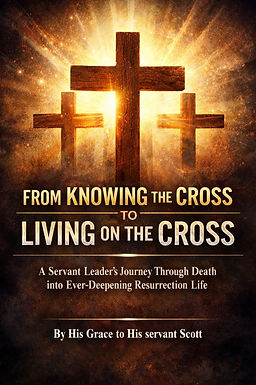
There is a difference, and it is a costly one, between knowing the cross and living on the cross. Many servant leaders can speak of it, teach it, defend it, and even build entire ministries around it, yet have never truly yielded themselves to its work. The cross can become something we circle, something we admire from a distance, something we understand intellectually—but not something we have entered into personally. Jesus did not say to admire the cross; He said, “If anyone would come after Me, let him deny himself and take up his cross daily and follow Me” (Luke 9:23). The invitation was never information—it was participation.
Paul gives us language that goes far beyond theory when he declares, “I have been crucified with Christ. It is no longer I who live, but Christ lives in me” (Galatians 2:20). This is not poetic expression; this is experiential surrender. There comes a moment in a servant leader’s life where the cross is no longer a message preached but a place entered. It is where control is relinquished, rights are laid down, identity is stripped of self-definition, and the inward throne is surrendered fully to Christ. This kind of death is not comfortable. It feels like loss. It feels like weakness. It feels like everything within us that once held us together is being undone. Yet Jesus reminds us, “Unless a grain of wheat falls into the earth and dies, it remains alone; but if it dies, it bears much fruit” (John 12:24). Without death, there is no multiplication. Without surrender, there is no fruit that carries eternal weight.
When a servant leader truly enters this death, something miraculous follows—not manufactured, not strived for, but given. Resurrection life begins to emerge. There is a new peace that is not dependent on circumstances, a new authority that is not rooted in personality, and a new influence that is not driven by effort. Paul longed for this reality when he said, “that I may know Him and the power of His resurrection” (Philippians 3:10). This resurrection life is the evidence that the cross has truly done its work. It is not hype; it is transformation. It is not noise; it is substance. It is Christ in you, moving, living, and leading.
Yet here is where many servant leaders unknowingly stall. After experiencing a genuine work of death and resurrection, there is a subtle temptation to settle—to build identity around what God has already done rather than remain surrendered to what He is still doing. What was once a step of radical obedience can quietly become a place of comfort. But the kingdom does not move forward on yesterday’s surrender. Jesus’ call remains present and active. The same cross that first transformed us will now call us deeper still.
In God’s sovereign timing, He begins to lift the servant leader into new areas—new responsibilities, new influence, new exposure—and with it comes a new invitation: another death. Not a repetition of the first, but a deeper layer of it. Hidden motives are revealed. Subtle pride is exposed. Areas of self that once went unnoticed are brought into the light. This can feel like disruption, even confusion, but “the Lord disciplines the one He loves” (Hebrews 12:6). What feels like interruption is often invitation. What feels like loss is often preparation.
This is where we begin to understand the difference between dying daily and entering deeper deaths. Paul said, “I die daily” (1 Corinthians 15:31), speaking of a continual posture of surrender. But throughout his life, we also see moments of profound, identity-shaping surrender—places where God dealt with him at a deeper level. The seasoned servant leader learns that while daily surrender maintains alignment, there are seasons where God calls for something more costly—something that reaches deeper into the core of who we are.
The second and third “crosses,” so to speak, do not carry the same confusion as the first, but they are not without pain. The difference is not the absence of suffering, but the presence of trust. Where there was once resistance, there is now a willingness. Where there was once fear, there is now faith. Yet even still, obedience is learned through what we suffer, just as it was written of Jesus, “Although He was a Son, He learned obedience through what He suffered” (Hebrews 5:8). Maturity does not eliminate the cost—it aligns the heart to embrace it.
Through this ongoing work, something greater than behavior change is taking place. “Christ in you, the hope of glory” (Colossians 1:27) is not formed in a moment, but through a process of repeated surrender and resurrection. Each death removes more of self—more pride, more fear, more control—and each resurrection reveals more of Christ—His humility, His strength, His love. This is the true formation of a servant leader. Not giftedness, not platform, not recognition—but Christ formed within.
The posture required in this journey is not striving, but submission. “Submit yourselves therefore to God” (James 4:7). The servant leader who grows is not the one who tries to control the process, but the one who yields to it. Jesus Himself modeled this perfectly, saying, “The Son can do nothing of His own accord, but only what He sees the Father doing” (John 5:19). This is the rhythm of true leadership—watching, yielding, obeying.
The life of a servant leader is not marked by a single encounter with the cross, but by a pattern: death, resurrection, invitation, deeper death, greater resurrection. Paul captures this ongoing reality when he writes, “always carrying in the body the death of Jesus, so that the life of Jesus may also be manifested in our bodies” (2 Corinthians 4:10). The cross is not an event we visit; it is a life we live.
And in this life, true authority is formed—not from what we know, not from what we have done, but from how deeply we have allowed the cross to do its work within us.
