August 6
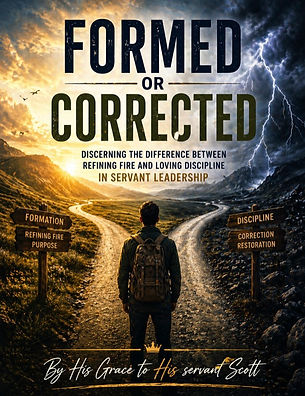
Formed or Corrected
Discerning the Difference Between Refining Fire and Loving Discipline in Servant Leadership

A servant leader must learn to discern the difference between being formed by God and being corrected by God, because both can feel like pressure, both can involve pain, and both can humble a man—but they are not the same in purpose or response. If you mislabel what God is doing, you will respond wrong, and when you respond wrong, you prolong seasons that were never meant to last. Scripture gives us clarity if we are willing to stay honest before the Lord. There is a suffering that comes from walking with God, and there is a suffering that comes from stepping outside of His will. One produces deeper intimacy; the other calls for repentance and realignment.
There is a suffering that is holy, where God is forming Christ within you. Jesus Himself walked this path. “Though He was a Son, yet He learned obedience by the things which He suffered” (Hebrews 5:8). This is not punishment—this is formation. This is the pruning that Jesus spoke of in John 15:2, “Every branch that bears fruit He prunes, that it may bear more fruit.” Notice that pruning is not for the fruitless, but for the fruitful. God will allow pressure in a leader’s life not to break them, but to deepen them. In these seasons, you are abiding, you are seeking, you are walking in obedience, yet God allows weight to shape your character. Formation produces endurance, and endurance produces depth. “We glory in tribulations, knowing that tribulation produces perseverance; and perseverance, character; and character, hope” (Romans 5:3–4). There is a quiet witness of God’s presence in this kind of suffering. Even when it hurts, you know He is near.
But then there is discipline, and a servant leader must not confuse the two. Discipline comes when we have sown something in the flesh, when pride, compromise, or disobedience has opened a door, and now we are experiencing the result of it. This is not the enemy attacking nearly as much as it is a harvest coming back. “Do not be deceived, God is not mocked; for whatever a man sows, that he will also reap” (Galatians 6:7). Yet because we are leaders, it is easy to spiritualize what is actually correction. We call it warfare when it is consequence. We call it persecution when it is exposure. But God, in His mercy, does not leave us there. “For whom the Lord loves He chastens, and scourges every son whom He receives” (Hebrews 12:6). Discipline is not rejection—it is alignment. It is God saying, “I love you too much to let you stay this way.”
Here is where discernment becomes everything. Formation will usually come while you are walking in the light, while your heart is open before God, while there is no hidden resistance in you. It stretches you beyond comfort, but it does not carry the weight of unresolved conviction. Discipline, on the other hand, often comes after the Spirit has already been speaking, warning, and prompting—and those promptings were ignored or delayed. Formation refines what is surrendered; discipline confronts what is not. Formation draws you deeper into abiding. Discipline calls you back into it.
A servant leader must refuse both deception and condemnation. If you mistake discipline for formation, you will endure what you were meant to repent of, and you will stay in cycles longer than necessary. If you mistake formation for discipline, you will fall into condemnation and draw back when God is actually inviting you deeper. “There is therefore now no condemnation to those who are in Christ Jesus” (Romans 8:1). God does not crush His sons—He forms them. And when He corrects them, it is always with the intention of restoring them.
The posture of a true servant leader is not to assume, but to examine. David prayed, “Search me, O God, and know my heart; try me, and know my anxieties; and see if there is any wicked way in me, and lead me in the way everlasting” (Psalm 139:23–24). That prayer keeps a leader clean. It keeps them from blaming others, from blaming the enemy, and from hiding behind spiritual language. It brings them into truth. Because at the end of the day, God is not just after your ministry—He is after your heart. He is forming Christ in you. “My little children, for whom I labor in birth again until Christ is formed in you” (Galatians 4:19).
So when pressure comes, don’t just endure it—discern it. Ask the Lord, “Is this refining me, or correcting me?” If it is formation, stay faithful, stay surrendered, and let Him deepen you. If it is discipline, humble yourself quickly, repent, and realign. Either way, His hand is on you, and His goal is the same—that Christ would be fully formed in your life, not just preached through your mouth.
Recent Devotionals
Constituido O Corregido
Discernir La Diferencia Entre El Fuego Purificador Y La Disciplina Amorosa En El Liderazgo Servicial
Un líder siervo debe aprender a discernir la diferencia entre ser formado por Dios y ser corregido por Dios, porque ambas cosas pueden sentirse como presión, ambas pueden implicar dolor y ambas pueden humillar a una persona, pero no tienen el mismo propósito ni requieren la misma respuesta. Si interpretas mal lo que Dios está haciendo, responderás mal, y cuando respondes mal, prolongas etapas que nunca debieron durar. Las Escrituras nos dan claridad si estamos dispuestos a mantenernos sinceros delante del Señor. Hay un sufrimiento que surge de caminar con Dios, y hay un sufrimiento que surge de apartarse de Su voluntad. Uno produce una intimidad más profunda; el otro exige arrepentimiento y volver a alinearse con Su voluntad.
Hay un sufrimiento santo, en el que Dios forma a Cristo en ti. Jesús mismo recorrió este camino.
Pero también está la disciplina, y un líder siervo no debe confundir ambas cosas. La disciplina llega cuando hemos sembrado en la carne, cuando el orgullo, la transigencia o la desobediencia han abierto una puerta y ahora estamos experimentando sus consecuencias. Esto tiene mucho menos que ver con un ataque del enemigo que con una cosecha que vuelve a nosotros.
Aquí es donde el discernimiento se vuelve fundamental. Por lo general, la formación ocurre mientras caminas en la luz, mientras tienes el corazón abierto delante de Dios y no hay en ti resistencia oculta. Te lleva más allá de tu zona de comodidad, pero no conlleva el peso de una convicción pendiente de resolver. La disciplina, en cambio, suele llegar después de que el Espíritu ya ha estado hablando, advirtiendo y guiando, y de que esas indicaciones fueron ignoradas o postergadas. La formación refina lo que se ha rendido; la disciplina confronta lo que no se ha rendido. La formación te acerca más a permanecer en Él. La disciplina te llama a volver a hacerlo.
Un líder siervo debe rechazar tanto el engaño como la condenación. Si confundes la disciplina con la formación, soportarás algo de lo que debías arrepentirte y permanecerás en ciertos ciclos más tiempo del necesario. Si confundes la formación con la disciplina, caerás en la condenación y te alejarás cuando, en realidad, Dios te está invitando a profundizar más.
La actitud de un verdadero líder siervo no es dar nada por sentado, sino examinarse. David oró:
Así que, cuando llegue la presión, no te limites a soportarla: discierne lo que significa. Pregúntale al Señor: «¿Esto me está refinando o corrigiendo?». Si es formación, mantente fiel, sigue rindiéndote a Él y deja que te haga profundizar. Si es disciplina, humíllate pronto, arrepiéntete y vuelve a alinearte con Su voluntad. En cualquier caso, Su mano está sobre ti, y Su propósito es el mismo: que Cristo se forme plenamente en tu vida, y no solo sea predicado por tu boca.
已形成或已更正
辨明仆人式领导中炼净之火与慈爱管教的区别
服事型领袖必须学会分辨:被神塑造和被神管教有什么不同。因为两者都可能让人感到压力,都可能伴随着痛苦,也都能使人谦卑——但它们的目的和我们应有的回应并不相同。如果你误判了神正在做的事,就会作出错误的回应;而一旦回应错了,你就会延长那些本不该持续那么久的时期。只要我们愿意在主面前诚实,圣经就能使我们明白。有一种苦难来自与神同行,也有一种苦难来自偏离祂的旨意。一种使我们与神的亲密关系更加深厚;另一种则呼唤我们悔改并重新归正。
有一种神圣的苦难,是神在你里面塑造基督的过程。耶稣自己也走过这条路。
但还有管教,服事型领袖绝不可将二者混为一谈。当我们顺着肉体撒下种子——当骄傲、妥协或悖逆敞开了一扇门——管教就会临到,我们也开始承受由此带来的后果。这与其说是仇敌在攻击,不如说是我们所撒的种子结出了果子。
这正是分辨力至关重要的地方。塑造通常发生在你行在光明中、向神敞开心扉、内心没有暗藏抗拒的时候。它会带你走出舒适区,却不会带着那种尚未处理的定罪感。另一方面,管教往往发生在圣灵已经向你说话、警告你、催促你之后——而你却忽视了这些提醒,或一再拖延回应。塑造炼净已经降服的部分;管教则直面尚未降服的部分。塑造带你更深地住在主里面;管教则呼唤你回到祂里面。
服事型领袖必须拒绝欺骗,也拒绝定罪。如果你把管教误当成塑造,就会忍受本该悔改的事,在循环中停留得比必要的时间更久。如果你把塑造误当成管教,就会陷入定罪,并在神实际上正邀请你更深亲近祂时退缩。
真正的服事型领袖不会妄下判断,而是会省察自己。大卫曾这样祷告:
所以,当压力临到时,不要只是忍受——要分辨。求问主:“这是在炼净我,还是在纠正我?”如果这是塑造,就要忠心持守、继续降服,让祂使你更加成熟。如果这是管教,就要迅速谦卑下来,悔改并重新归正。无论是哪一种,祂的手都在你身上;祂的目标始终相同——让基督完全成形在你的生命里,而不只是借着你的口被传讲出来。
请提供要翻译的英文文本。