May 11
Doing vs Being
A Servant Leader’s Formation Beyond Gifting
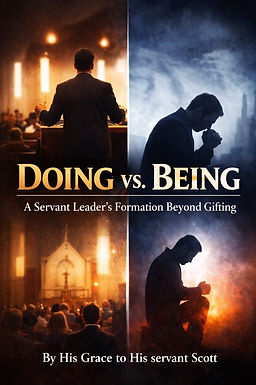
One of the most defining tensions in the life of a servant leader is the difference between doing and being. It is subtle, yet it determines everything. A leader can spend years doing—serving, teaching, building, leading—and yet never fully allow God to shape who they are becoming. The danger is not in doing itself, but in doing without being formed. Scripture reminds us that “man looks at the outward appearance, but the Lord looks at the heart” (1 Samuel 16:7). God’s focus has never been primarily on what we accomplish outwardly, but on what is being developed inwardly. A servant leader must come to terms with this reality: God is more concerned with who we are becoming than what we are producing.
This confronts one of the quiet misconceptions in ministry—that our gifting, education, or position qualifies us for leadership. While these things have value, they are not the foundation. A person can attend the best seminary, gain deep theological understanding, and even step into influential positions, yet still lack the character necessary to sustain what God entrusts to them. Knowledge can inform, but it does not automatically transform. As Paul writes, “knowledge puffs up, but love builds up” (1 Corinthians 8:1). Information without formation creates leaders who can speak truth but have not been shaped by it. And when truth has not passed through the cross within a person, it will eventually lack the weight to carry others.
At the core of this is a deeper issue—whose glory is being pursued. God does not need our gifts to accomplish His purposes. He is not limited by our abilities, nor is He dependent on our strength. “Apart from Me you can do nothing” (John 15:5). His aim is not to magnify the servant, but to reveal Himself through the servant. When doing becomes the focus, it is easy for subtle self-exaltation to take root. But when being becomes the focus, humility is formed, dependence is deepened, and Christ is revealed. John the Baptist captured this posture clearly: “He must increase, but I must decrease” (John 3:30). This is not just a statement of humility—it is the pathway of true servant leadership.
God, in His faithfulness, will not allow His servants to bypass this process of formation. He brings us into what can only be described as the graduate school of life. Through trials, relationships, disappointments, hidden seasons, and even our own weaknesses, He exposes what is within us. Not to condemn us, but to transform us. James writes, “the testing of your faith produces perseverance. Let perseverance finish its work so that you may be mature and complete” (James 1:3–4). These processes are not interruptions to ministry—they are the preparation for it. What feels like delay is often development. What feels like pressure is often refinement.
A servant leader must also understand that doing and being are not enemies, but they must be in proper order. Doing flows from being. Ministry is meant to be an overflow, not a substitute. Jesus warned of those who honor God with their lips while their hearts remain distant (Matthew 15:8). It is possible to function in ministry while neglecting intimacy with God. It is possible to lead others while avoiding personal surrender. But this creates a dangerous imbalance. When activity replaces transformation, the outward structure may grow, but the inward life becomes hollow. And over time, what is unformed will be exposed.
This is why character is not optional in servant leadership—it is foundational. Gifting may open doors, but character determines whether a leader can remain standing once those doors are opened. Scripture consistently points to fruit, not performance, as the evidence of a life aligned with God. “By their fruit you will recognize them” (Matthew 7:16). Fruit takes time. It requires abiding. It is developed in hidden places long before it is seen publicly. A leader whose skills exceed their character may experience temporary success, but eventually, the weight of leadership will reveal the cracks that were never addressed.
True, lasting ministry flows from a life that has been tempered, shaped, and matured through God’s processes. It is a life that has learned dependence, embraced humility, and allowed the cross to do its work within. Paul writes, “we have this treasure in jars of clay to show that this all-surpassing power is from God and not from us” (2 Corinthians 4:7). The strength of a servant leader is not found in their ability, but in their surrender. Not in their performance, but in their formation.
The call, then, is clear. Do not build your life on doing alone. Do not measure your effectiveness by activity, recognition, or results. Instead, allow God to focus on what He has always been after—your heart. Let Him shape your character in the hidden places. Let Him deal with what no one else sees. Because in the end, it is not what we have done for God that sustains ministry, but what God has done in us. From that place, doing is no longer striving—it becomes the natural overflow of a life that has truly been with Him.
Recent Devotionals

Hacer Vs. Ser
La Formación De Un Líder Servidor Más Allá De Sus Dones
Una de las tensiones más decisivas en la vida de un líder siervo es la diferencia entre hacer y ser. Es sutil, pero lo determina todo. Un líder puede pasar años haciendo —sirviendo, enseñando, construyendo, liderando— y, aun así, nunca permitir plenamente que Dios moldee en quién se está convirtiendo. El peligro no está en hacer en sí, sino en hacer sin dejarse formar. Las Escrituras nos recuerdan que «el hombre mira lo que está delante de sus ojos, pero el Señor mira el corazón» (1 Samuel 16:7). A Dios nunca le ha importado principalmente lo que logramos externamente, sino lo que se está desarrollando en nuestro interior. Un líder siervo debe aceptar esta realidad: a Dios le importa más en quién nos estamos convirtiendo que lo que estamos produciendo.
Esto pone en tela de juicio una de las ideas equivocadas más arraigadas en el ministerio: que nuestros dones, nuestra formación académica o nuestro cargo nos capacitan para liderar. Aunque estas cosas tienen valor, no son el fundamento. Una persona puede asistir al mejor seminario, adquirir un profundo conocimiento teológico e incluso ocupar puestos de influencia, y aun así carecer del carácter necesario para sostener aquello que Dios le confía. El conocimiento puede instruir, pero no transforma automáticamente. Como escribe Pablo: «el conocimiento envanece, pero el amor edifica» (1 Corintios 8:1). La información sin formación crea líderes capaces de hablar de la verdad, pero que no han sido moldeados por ella. Y cuando la verdad no ha pasado por la cruz en la vida de una persona, tarde o temprano le faltará el peso necesario para sostener a otros.
En el fondo, hay una cuestión más profunda: ¿la gloria de quién estamos buscando? Dios no necesita nuestros dones para llevar a cabo sus propósitos. No está limitado por nuestras capacidades ni depende de nuestras fuerzas. «Separados de mí nada podéis hacer» (Juan 15:5). Su propósito no es engrandecer al siervo, sino revelarse a través de él. Cuando el hacer se convierte en el centro, es fácil que arraigue una sutil exaltación propia. Pero cuando el centro es el ser, se forma la humildad, se profundiza la dependencia y Cristo se revela. Juan el Bautista expresó claramente esta actitud: «Es necesario que él crezca, y que yo mengüe» (Juan 3:30). No es solo una declaración de humildad: es el camino del verdadero liderazgo de servicio.
Dios, en su fidelidad, no permitirá que sus siervos se salten este proceso de formación. Nos lleva a lo que solo puede describirse como la escuela de posgrado de la vida. Por medio de las pruebas, las relaciones, las decepciones, las etapas ocultas e incluso nuestras propias debilidades, saca a la luz lo que hay dentro de nosotros. No para condenarnos, sino para transformarnos. Santiago escribe: «la prueba de vuestra fe produce perseverancia. Y que la perseverancia complete su obra, para que seáis maduros y cabales» (Santiago 1:3–4). Estos procesos no son interrupciones en el ministerio: son su preparación. Lo que parece una demora suele ser desarrollo. Lo que parece presión suele ser refinamiento.
Un líder siervo también debe entender que hacer y ser no son enemigos, pero deben estar en el orden correcto. El hacer fluye del ser. El ministerio debe ser un desbordamiento, no un sustituto. Jesús advirtió acerca de quienes honran a Dios con sus labios mientras su corazón permanece lejos de él (Mateo 15:8). Es posible desempeñarse en el ministerio y descuidar la intimidad con Dios. Es posible guiar a otros y evitar rendirse personalmente. Pero esto crea un desequilibrio peligroso. Cuando la actividad sustituye a la transformación, la estructura externa puede crecer, pero la vida interior se vuelve hueca. Y, con el tiempo, quedará expuesto aquello que no ha sido formado.
Por eso, el carácter no es opcional en el liderazgo de servicio: es fundamental. Los dones pueden abrir puertas, pero el carácter determina si un líder podrá mantenerse en pie una vez que esas puertas se abran. Las Escrituras señalan constantemente el fruto, no el desempeño, como prueba de una vida alineada con Dios: «por sus frutos los conoceréis» (Mateo 7:16). El fruto requiere tiempo. Requiere permanecer. Se desarrolla en lugares ocultos mucho antes de hacerse visible en público. Un líder cuyas habilidades superan su carácter puede alcanzar un éxito temporal, pero, tarde o temprano, el peso del liderazgo revelará las grietas que nunca fueron reparadas.
El ministerio verdadero y duradero fluye de una vida que ha sido templada, moldeada y madura mediante los procesos de Dios. Es una vida que ha aprendido a depender, ha abrazado la humildad y ha permitido que la cruz haga su obra en su interior. Pablo escribe: «tenemos este tesoro en vasos de barro, para que la excelencia del poder sea de Dios, y no de nosotros» (2 Corintios 4:7). La fortaleza de un líder siervo no se encuentra en sus capacidades, sino en su entrega. No en su desempeño, sino en su formación.
El llamado, entonces, es claro. No construyas tu vida basándote únicamente en hacer. No midas tu eficacia por la actividad, el reconocimiento o los resultados. En cambio, permite que Dios se centre en aquello que siempre ha buscado: tu corazón. Deja que moldee tu carácter en los lugares ocultos. Deja que trate aquello que nadie más ve. Porque, al final, lo que sostiene el ministerio no es lo que hemos hecho para Dios, sino lo que Dios ha hecho en nosotros. Desde ese lugar, hacer ya no es esforzarse: se convierte en el desbordamiento natural de una vida que verdaderamente ha estado con él.
行动与存在
仆人领袖的塑造:超越恩赐
在仆人领袖的一生中,最关键的张力之一,就是“做事”与“成为”之间的区别。这种区别很微妙,却决定着一切。一个领袖可能多年忙于做事——服侍、教导、建造、带领——却始终没有完全让上帝塑造自己正在成为的样子。危险不在于做事本身,而在于做事却没有让生命得着塑造。圣经提醒我们:“人是看外貌;耶和华是看内心”(撒母耳记上 16:7)。上帝关注的从来不主要是我们在外面成就了什么,而是我们的内在正在形成什么。仆人领袖必须正视这一现实:比起我们做出了什么,上帝更关心我们正在成为怎样的人。
这也直指服侍事工中一个不易察觉的误区——以为恩赐、教育背景或职位就足以使我们胜任领袖。尽管这些都有价值,却不是根基。一个人可以进入最好的神学院,获得深厚的神学知识,甚至身居重要职位,却仍缺乏承受上帝托付之重任所需的品格。知识可以让人明白道理,却不会自动带来生命改变。正如保罗所写:“知识使人自高自大,惟有爱心能造就人”(哥林多前书 8:1)。没有生命塑造的信息,会造就出这样的领袖:他们能讲述真理,生命却未曾受真理塑造。真理若没有在一个人里面经过十字架的炼净,最终便缺乏承载他人的分量。
问题的核心还在于一个更深层的层面——我们追求的是谁的荣耀。上帝不需要借助我们的恩赐来成就祂的旨意。祂不受我们的能力限制,也不依赖我们的力量。“离了我,你们就不能做什么”(约翰福音 15:5)。祂的目的不是高举仆人,而是借着仆人彰显祂自己。当做事成为焦点时,隐约的自我高举很容易扎根;而当生命成为焦点时,谦卑便得以塑造,倚靠也更加深厚,基督便得以显明。施洗约翰清楚表达了这样的态度:“他必兴旺,我必衰微”(约翰福音 3:30)。这不仅是一句谦卑的话,更是真正仆人式领导的道路。
上帝信实,祂不会让自己的仆人绕过生命塑造的过程。祂带领我们进入一种只能称作“人生研究生院”的历程。借着试炼、人际关系、失望、无人看见的岁月,甚至我们自身的软弱,祂显明我们里面的光景。祂这样做不是要定我们的罪,而是要改变我们。雅各写道:“因为知道你们的信心经过试验,就生忍耐。但忍耐也当成功,使你们成全、完备,毫无缺欠”(雅各书 1:3–4)。这些历程不是对事工的打断,而是为事工做预备。我们感觉像是耽搁的时刻,往往正是在成长;感觉像是压力的处境,往往正是在炼净。
仆人领袖也必须明白,做事与成为并非彼此对立,但两者必须有恰当的次序。做事应当从生命中流露出来。事工本应是丰盛生命的自然流溢,而不是生命的替代品。耶稣曾警告那些嘴唇尊敬上帝、内心却远离祂的人(马太福音 15:8)。一个人可能在事工中忙碌,却忽略与上帝的亲密关系;也可能带领他人,却逃避个人的降服。然而,这会造成危险的失衡。当活动取代生命改变,外在架构或许不断壮大,内在生命却会变得空洞。久而久之,未曾受塑造的部分终将显露出来。
正因如此,品格对于仆人式领导并非可有可无,而是根基。恩赐或许能打开门,但门打开之后,品格才决定领袖能否站立得住。圣经一再指出,与上帝相合的生命,其凭据是果子,而非表现。“凭着他们的果子,就可以认出他们来”(马太福音 7:16)。果子需要时间才能结出,需要常在基督里面;在公开显现之前,它早已在无人看见之处生长。若一个领袖的能力超过了他的品格,或许能暂时成功,但最终,领导重担会显露出那些从未处理过的裂痕。
真正持久的事工,源自一颗经过上帝熬炼、塑造并成熟的生命。这生命学会了倚靠,拥抱了谦卑,也让十字架在里面作成它的工作。保罗写道:“我们有这宝贝放在瓦器里,要显明这莫大的能力是出于上帝,不是出于我们”(哥林多后书 4:7)。仆人领袖的力量不在于自身的能力,而在于降服;不在于表现,而在于生命的塑造。
因此,呼召是清楚的:不要只靠做事来建造你的人生;不要以活动、认可或成果来衡量自己的果效。相反,要让上帝专注于祂始终在意的事——你的内心。让祂在无人看见之处塑造你的品格;让祂处理那些无人看见的部分。因为到头来,支撑事工的不是我们为上帝做了什么,而是上帝在我们里面做成了什么。从这样的生命中,做事便不再是竭力挣扎,而是一个真正与祂同行的生命自然流露出来的丰盛。
请提供需要翻译的英文文本。