Activeness = Life
February 2
When Growth Stops, Decay Begins
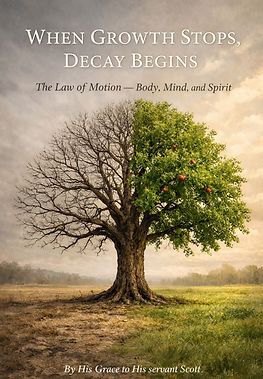
God did not create any part of us to remain static. From the beginning, life was designed for movement, cultivation, and increase. In the garden, Adam was not told to admire creation but to tend it and keep it (Genesis 2:15). What is not tended does not remain neutral—it deteriorates. This is true physically, mentally, and spiritually.
The human body makes this clear. When muscles are not used, they weaken. When the body stops moving, systems begin to shut down. Scripture affirms this principle of embodied stewardship: “Do you not know that your bodies are temples of the Holy Spirit… Therefore honor God with your bodies” (1 Corinthians 6:19–20). Movement, work, and care are not about vanity—they are about stewardship. When the body receives the message that it is no longer needed, decline accelerates.
The mind follows the same design. God calls His people to continual renewal, not mental retirement. “Be transformed by the renewing of your mind” (Romans 12:2) is not a one-time event—it is an ongoing process. When learning stops, when curiosity fades, the mind begins to regress into repetition and rigidity. Scripture warns of this dulling: “Though by this time you ought to be teachers, you need someone to teach you again the basic principles” (Hebrews 5:12). Stagnation masquerades as maturity, but true wisdom remains teachable.
Spiritually, the danger is greatest. Many believers reach a point where growth slows and comfort takes its place. But Scripture never presents the Christian life as maintenance. We are told to “walk by the Spirit” (Galatians 5:16), to “press on toward the goal” (Philippians 3:13–14), and to be “renewed day by day” (2 Corinthians 4:16). God’s work in us is progressive— “being transformed into His image from one degree of glory to another” (2 Corinthians 3:18). When a person resists this ongoing surrender, spiritual life does not plateau—it hardens.
This is why Scripture consistently associates life with motion. We are called to walk, run, grow, build, bear fruit, and finish well. Jesus Himself said, “Every branch in Me that does not bear fruit He takes away… and every branch that does bear fruit He prunes, that it may bear more fruit” (John 15:2). Pruning is not punishment—it is preparation. Growth continues because God continues shaping.
As people age, this truth becomes visible. Many step into retirement not only from work but from purpose. When activity, contribution, and engagement cease, decline often follows quickly. Yet Scripture never assigns an expiration date to fruitfulness: “They will still bear fruit in old age, they will stay fresh and green” (Psalm 92:14). The problem is not aging—it is disengagement from God’s ongoing call.
The lie many believe is that there is a finish line where striving ends and life coasts. But Scripture teaches otherwise. True rest is not inactivity—it is alignment with God. “Come to Me… and I will give you rest” (Matthew 11:28), not escape. Biblical rest restores us for obedience, not withdrawal. False rest replaces surrender with comfort and slowly signals that growth is no longer necessary.
The truth is both sobering and hopeful: in every area God has created us—body, mind, and spirit—there is no neutral ground. “Whoever is not with Me is against Me” (Matthew 12:30). If we are not being renewed, we are being reduced. Growth does not stop because we age; often, we age faster when growth stops.
God’s design has always been lifelong formation—spirit, soul, and body 1 Thessalonians 5:23 —being continually shaped until the end. Scripture assures us, “He who began a good work in you will carry it on to completion until the day of Christ Jesus” (Philippians 1:6). That completion does not mean inactivity or arrival at some static spiritual state; it means faithful, ongoing transformation as long as we have breath. Paul echoes this truth when he prays, “May God Himself, the God of peace, sanctify you through and through; may your whole spirit, soul, and body be kept blameless at the coming.
Recent Devotionals


Actividad = Vida
Cuando El Crecimiento Se Detiene, Comienza El Deterioro
Dios no creó ninguna parte de nosotros para que permaneciera estática. Desde el principio, la vida fue concebida para el movimiento, el cultivo y el crecimiento. En el jardín, a Adán no se le dijo que admirara la creación, sino que la cuidara y la conservara (Génesis 2:15). Lo que no se cuida no permanece inalterado, sino que se deteriora. Esto es cierto a nivel físico, mental y espiritual.
El cuerpo humano lo deja claro. Cuando los músculos no se utilizan, se debilitan. Cuando el cuerpo deja de moverse, los sistemas comienzan a fallar. Las Escrituras afirman este principio de la mayordomía del cuerpo: «¿No sabéis que vuestros cuerpos son templos del Espíritu Santo…? Por tanto, honrad a Dios con vuestros cuerpos» (1 Corintios 6:19–20). El movimiento, el trabajo y el cuidado no tienen que ver con la vanidad, sino con la mayordomía. Cuando el cuerpo recibe el mensaje de que ya no es necesario, el deterioro se acelera.
La mente sigue el mismo diseño. Dios llama a su pueblo a una renovación continua, no a un retiro mental. «Dejad que os transforme la renovación de vuestra mente» (Romanos 12:2) no es un acontecimiento puntual, sino un proceso continuo. Cuando se detiene el aprendizaje, cuando la curiosidad se desvanece, la mente comienza a retroceder hacia la repetición y la rigidez. Las Escrituras advierten de este embotamiento: «Aunque a estas alturas ya deberíais ser maestros, necesitáis que alguien os vuelva a enseñar los principios básicos» (Hebreos 5:12). El estancamiento se disfraza de madurez, pero la verdadera sabiduría sigue siendo receptiva a la enseñanza.
Espiritualmente, el peligro es mayor. Muchos creyentes llegan a un punto en el que el crecimiento se ralentiza y la comodidad ocupa su lugar. Pero las Escrituras nunca presentan la vida cristiana como un mero mantenimiento. Se nos dice que «andemos según el Espíritu» (Gálatas 5:16), que «prosigamos hacia la meta» (Filipenses 3:13–14) y que seamos «renovados día a día» (2 Corintios 4:16). La obra de Dios en nosotros es progresiva: «somos transformados a su imagen, de gloria en gloria» (2 Corintios 3:18). Cuando una persona se resiste a esta entrega continua, la vida espiritual no se estanca, sino que se endurece.
Por eso las Escrituras asocian constantemente la vida con el movimiento. Estamos llamados a caminar, correr, crecer, edificar, dar fruto y terminar bien. El propio Jesús dijo: «Toda rama que en mí no da fruto, la quita… y toda rama que da fruto, la poda, para que dé más fruto» (Juan 15:2). La poda no es un castigo, es una preparación. El crecimiento continúa porque Dios sigue moldeándonos.
A medida que las personas envejecen, esta verdad se hace evidente. Muchos se jubilan no solo del trabajo, sino también de su propósito. Cuando cesan la actividad, la contribución y el compromiso, el declive suele seguir rápidamente. Sin embargo, las Escrituras nunca asignan una fecha de caducidad a la fecundidad: «Aún en la vejez darán fruto; seguirán frescos y verdes» (Salmo 92:14). El problema no es el envejecimiento, sino el alejamiento del llamado continuo de Dios.
La mentira en la que muchos creen es que existe una línea de meta donde el esfuerzo termina y la vida sigue su curso sin más. Pero las Escrituras enseñan lo contrario. El verdadero descanso no es la inactividad, sino la alineación con Dios. «Venid a mí… y yo os daré descanso» (Mateo 11:28), no una huida. El descanso bíblico nos restaura para la obediencia, no para el retraimiento. El falso descanso sustituye la rendición por la comodidad y, poco a poco, nos indica que el crecimiento ya no es necesario.
La verdad es a la vez aleccionadora y esperanzadora: en cada ámbito en el que Dios nos ha creado —cuerpo, mente y espíritu— no hay terreno neutral. «El que no está conmigo, está contra mí» (Mateo 12:30). Si no nos renovamos, nos estamos estancando. El crecimiento no se detiene porque envejecemos; a menudo, envejecemos más rápido cuando el crecimiento se detiene.
El diseño de Dios siempre ha sido la formación a lo largo de toda la vida —espíritu, alma y cuerpo (1 Tesalonicenses 5:23)—, siendo moldeados continuamente hasta el final. Las Escrituras nos aseguran: «El que comenzó en vosotros la buena obra, la llevará a cabo hasta el día de Cristo Jesús» (Filipenses 1:6). Esa culminación no significa inactividad ni la llegada a un estado espiritual estático; significa una transformación fiel y continua mientras tengamos aliento. Pablo se hace eco de esta verdad cuando reza: «Que Dios mismo, el Dios de la paz, os santifique por completo; que todo vuestro espíritu, alma y cuerpo sean conservados irreprochables para su venida
».活力=生命
当增长停止时,衰败便开始了
上帝创造我们的任何部分,都不是为了让它们一成不变。从起初,生命就被设计为不断运动、耕耘和增长。在伊甸园里,亚当受命不是去欣赏造物,而是去耕种它、看守它(《创世记》2:15)。 不加以照管的事物不会保持中立——它会逐渐衰败。这一点在身体、心理和灵性层面都成立。
人体对此作了清晰的说明。 肌肉若不使用,就会萎缩;身体一旦停止活动,各项机能便会开始衰竭。圣经肯定了这一关于身体管家职责的原则:“岂不知你们的身子就是圣灵的殿……所以,你们要借着自己的身子荣耀神”(《哥林多前书》6:19–20)。 运动、工作和关怀并非出于虚荣——而是关乎管家职责。当身体接收到“已不再被需要”的信号时,衰退便会加速。
心灵也遵循同样的设计。 神呼召祂的子民不断更新,而非让心灵“退休”。“不要效法这个世界,只要心意更新而变化”(罗马书 12:2)并非一次性的事件——而是一个持续的过程。当学习停止,当好奇心消退,心灵便开始退化,陷入重复与僵化。 圣经曾警告过这种灵性迟钝:“你们本该作师傅了,却还需要有人再教导你们那初学的道理”(希伯来书 5:12)。 停滞不前常伪装成成熟,但真正的智慧始终保持着可教性。
在属灵层面,这种危险最为严重。许多信徒到了某个阶段,成长便放缓,取而代之的是安于现状。但圣经从未将基督徒的生活描述为一种维持现状的状态。 经文吩咐我们要“靠着圣灵行事”(加拉太书 5:16),要“向着标竿直跑”(腓立比书 3:13–14),并要“日日更新”(哥林多后书 4:16)。 神在我们里面所做的工作是渐进的——“渐渐被改变,成为祂的形像,荣耀上加荣耀”(哥林多后书 3:18)。当一个人抗拒这种持续的顺服时,属灵生命不会停滞不前——而是会变得僵化。
这就是为什么圣经始终将生命与运动联系在一起。我们被呼召要行走、奔跑、成长、建造、结出果子,并善终。 耶稣亲自说:“凡在我里面的枝子,若不结果子,祂就剪去……凡结果子的,祂就修理干净,使它结果子更多”(约翰福音15:2)。修剪并非惩罚——而是预备。成长之所以持续,是因为神持续地塑造着我们。
随着人岁月的增长,这一真理便显而易见。许多人步入退休生活,不仅意味着离开工作岗位,更意味着失去人生目标。当活动、贡献和参与停止时,衰退往往紧随其后。 然而,圣经从未给结出果实设定过“有效期”:“他们年老的时候仍要结果子,要满了汁浆而常发青”(诗篇92:14)。问题不在于衰老——而在于脱离了上帝持续的呼召。
许多人相信的一个谎言是:存在一条终点线,越过它,奋斗便告终结,生活便顺其自然。但圣经所教导的却并非如此。真正的安息并非无所事事——而是与神同心。 “‘到我这里来……我就使你们得安息’”(马太福音 11:28),而非逃避。圣经所说的安息是为了使我们恢复力量以顺服,而非退缩。虚假的安息用安逸取代了顺服,并逐渐暗示成长已不再必要。
这个真理既发人深省又充满希望:在神所创造的我们每一个层面——身体、心思和灵——都没有中立之地。“不与我同在的,就是敌我”(马太福音 12:30)。 如果我们没有被更新,我们就在退步。成长不会因为我们变老而停止;往往,当成长停止时,我们才变老得更快。
上帝的计划一直都是终身塑造——灵、魂、体(帖撒罗尼迦前书 5:23)——直到终点都持续被塑造。 圣经向我们保证:“那在你们心里动了善工的,必成全这工,直到基督耶稣的日子”(腓立比书 1:6)。这种成全并不意味着停滞不前,或达到某种静止的属灵状态;它意味着只要我们还有一口气,就要忠心、持续地经历转变。 保罗在祷告中呼应了这一真理:“愿赐平安的神亲自使你们全然成圣;又愿你们的灵、魂、体在主降临的时候,都能无可指摘。