Restoration of God's Image
August 8, 2026
From Deadened Spirit to Christ Formed Within
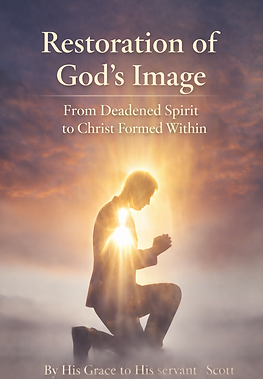
From the very beginning, God’s intention for humanity was never merely moral behavior or religious performance. God created man through His Word and formed him in His own image. Because God is Spirit, He gave man a spirit—not simply as a component of his being, but as the place where divine life could dwell. Humanity was designed to contain God, to live by His life, and to express His image from the inside out. Man was not created to live independently, but dependently—animated and sustained by the very life of God Himself.
This was the condition of man before the Fall. But when sin entered the world, the damage went far deeper than outward behavior. At the Fall, man’s spirit was deadened. The inner capacity to contain the life of God was lost, and the image of God within man became fractured. Man did not simply begin to do wrong things; he became inwardly separated from the life he was created to live by. Scripture later confirms this reality: “You were dead in your trespasses and sins” (Ephesians 2:1). Death, in biblical terms, is separation—and humanity became separated from the life of God at the deepest level of its being.
If God were ever to restore man to what He originally intended him to be, the restoration could not begin externally. Man’s spirit itself had to be restored. No amount of instruction, law, discipline, or effort could repair what had been lost. The problem was not a lack of information but a lack of life. Therefore, the solution had to be life imparted—not behavior corrected.
God’s answer to this problem was not a system, a method, or a moral code. His answer was a Person.
Restoration could come only through Jesus Christ. Jesus alone is the exact image of the Father (Hebrews 1:3). He alone fully contains and expresses the life of God without distortion. And He alone is able to impart that life back into man. When Christ comes into a person, He does not merely influence behavior; He gives life to the spirit. “I came that they may have life, and have it abundantly” (John 10:10). Through union with Christ, the deadened spirit is made alive, and the work of restoring the image of God begins from within.
Yet this restoration does not take place through human striving. A broken image cannot repair itself. A damaged canvas cannot correct its own flaws. In the same way, the soul cannot recreate the image of God through self-effort, discipline, or spiritual activity. The work of restoration belongs entirely to Christ. The role of the believer is not to act, but to yield.
Scripture tells us that Christ now dwells within the believer (Colossians 1:27). He has entered the innermost parts of our being, where His Spirit actively works to restore what was lost. Our only true participation in this process is surrender. When the self becomes active—trying to manage, fix, or produce transformation—it interferes with the Spirit’s work. Every movement of self-effort introduces distortion. But when the soul remains at rest, responsive only to the Spirit, Christ is free to engrave His image upon the heart.
Like an artist painting on a canvas, God requires stillness in order to work accurately. An unsteady canvas produces a distorted image. In the same way, a restless, striving soul disrupts the formation of Christ within. True spiritual growth is not found in trying harder, but in yielding deeper. “Be still, and know that I am God” (Psalm 46:10) is not merely a command for comfort—it is a principle of transformation.
This is the great paradox of the Christian life: transformation happens not through activity, but through surrender. Not through effort, but through trust. As we remain at peace under the hand of the divine Workman, Christ faithfully completes the work He alone can do—restoring the image of God and forming His own life within us.


