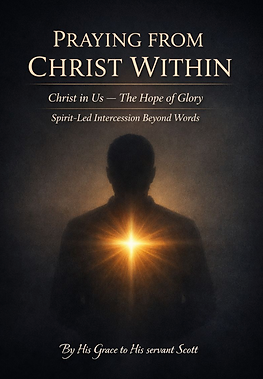
Praying From Christ Within: Christ In Us - The Hope of Glory
May 16
Spirit-Led Intercession Beyond Words
One of the most powerful shifts in a believer’s prayer life occurs when prayer moves from the head to the Spirit—from effort to union, from technique to participation. Scripture reveals this mystery plainly: “Christ in you, the hope of glory” (Colossians 1:27). Prayer was never designed to be merely something we do for God, but something God does through us. When Christ dwells within us by His Spirit, prayer becomes an expression of divine life rather than human striving.
Many believers pray sincerely yet struggle with fatigue, repetition, and frustration because prayer is often driven by information, emotion, or urgency rather than spiritual alignment. Head-driven prayer typically reacts to circumstances. We pray what we see, what we fear, or what we think should change. While such prayers are honest, they often remain external—attempts to persuade God rather than participate with Him. Scripture gently redirects us from this posture. “For who has known the mind of the Lord so as to instruct Him?” (Romans 11:34). Prayer is not meant to inform God, but to align us with His will.
The apostle Paul reveals a deeper reality: “The Spirit helps us in our weakness. For we do not know what to pray for as we ought, but the Spirit Himself intercedes for us” (Romans 8:26). This passage exposes a humbling truth—left to ourselves, we often do not know how to pray correctly. Spirit-directed prayer begins when we stop trying to lead prayer and instead yield to the One who already knows the Father’s will. Intercession becomes less about words and more about agreement.
Praying from Christ in us means praying from identity, not obligation. Jesus is not distant, waiting for perfect phrasing. He lives within the believer by the Holy Spirit, continually aligned with the Father. Scripture tells us that Christ “always lives to make intercession” (Hebrews 7:25). When we pray from union, we are not generating prayer—we are joining prayer already in progress. This removes pressure and replaces it with peace.
Spirit-directed prayer also transforms how we intercede for others. Instead of praying at problems or reacting to crises, we pray from God’s perspective toward people. “The Lord looks at the heart” (1 Samuel 16:7), and Spirit-led intercession allows God to reveal what lies beneath the surface. We begin to pray for transformation rather than control, healing rather than management, obedience rather than outcomes. This protects us from rescuing, emotional overload, and spiritual burnout.
Stillness becomes essential in this kind of prayer. Scripture reminds us, “Be still, and know that I am God” (Psalm 46:10). Silence is not absence—it is alignment. Listening prayer allows the Spirit to guide intercession rather than urgency dictating direction. Often the most powerful prayers are not spoken quickly, but received quietly. “The Lord is in His holy temple; let all the earth be silent before Him” (Habakkuk 2:20).
Authority flows naturally from union. Jesus said, “Apart from Me you can do nothing” (John 15:5). Prayer spoken from self-effort carries strain; prayer spoken from union carries authority. This authority is not volume or intensity—it is agreement. When we pray from Christ in us, we speak what heaven has already declared. “If we ask anything according to His will, He hears us” (1 John 5:14). Spirit-directed prayer bypasses anxiety because it rests in God’s initiative.
The fruit of praying from Christ in us is unmistakable. There is increased clarity, deeper compassion without exhaustion, confidence without control, and peace that guards the heart. “The peace of God, which surpasses all understanding, will guard your hearts and your minds in Christ Jesus” (Philippians 4:7). Prayer no longer feels like labor—it becomes communion.
Learning this posture requires intentional surrender. Prayer begins by acknowledging union rather than need. We come not asking God to join our perspective, but yielding ourselves to His. We listen before we speak, and when we speak, we speak in agreement. We release outcomes back to God, trusting His wisdom and timing. “Not my will, but Yours be done” (Luke 22:42).
Ultimately, prayer is not about getting God to move—it is about allowing Christ in us to move. Intercession becomes a sacred partnership rather than a spiritual task. When prayer flows from Christ in us, the hope of glory is no longer a concept—it becomes a living reality expressed through yielded lives.
Recent Devotionals


Orar Desde Cristo Que Habita En Nosotros: Cristo En Nosotros, Esperanza De Gloria
Intercesión Guiada Por El Espíritu Más Allá De Las Palabras
Uno de los cambios más poderosos en la vida de oración de un creyente ocurre cuando la oración pasa de la mente al Espíritu: del esfuerzo a la unión, de la técnica a la participación. Las Escrituras revelan claramente este misterio: «Cristo en ustedes, la esperanza de gloria» (Colosenses 1:27). La oración nunca fue concebida como algo que hacemos para Dios, sino como algo que Dios hace por medio de nosotros. Cuando Cristo habita en nosotros por medio de su Espíritu, la oración se convierte en una expresión de vida divina, en vez de un esfuerzo humano.
Muchos creyentes oran con sinceridad, pero luchan con el cansancio, la repetición y la frustración, porque a menudo la oración está impulsada por la información, las emociones o la urgencia, en lugar de por una sintonía espiritual. La oración guiada por la mente suele ser una reacción a las circunstancias. Oramos por lo que vemos, lo que tememos o lo que pensamos que debería cambiar. Aunque esas oraciones son sinceras, a menudo se quedan en lo externo: son intentos de persuadir a Dios, en vez de participar con Él. Las Escrituras nos apartan con delicadeza de esa actitud: «¿Quién ha conocido la mente del Señor para instruirlo?» (Romanos 11:34). La oración no pretende informarle a Dios, sino alinearnos con su voluntad.
El apóstol Pablo revela una realidad más profunda: «El Espíritu nos ayuda en nuestra debilidad, pues no sabemos qué pedir como conviene, pero el Espíritu mismo intercede por nosotros» (Romanos 8:26). Este pasaje pone al descubierto una verdad que nos llena de humildad: si dependemos de nosotros mismos, a menudo no sabemos cómo orar correctamente. La oración dirigida por el Espíritu comienza cuando dejamos de intentar dirigirla y, en cambio, nos rendimos ante Aquel que ya conoce la voluntad del Padre. La intercesión pasa a tener menos que ver con las palabras y más con estar de acuerdo.
Orar desde Cristo en nosotros significa orar desde nuestra identidad, no desde la obligación. Jesús no está distante, esperando que encontremos las palabras perfectas. Vive en el creyente por medio del Espíritu Santo y está continuamente en sintonía con el Padre. Las Escrituras nos dicen que Cristo «vive siempre para interceder» (Hebreos 7:25). Cuando oramos desde la unión con Él, no estamos generando la oración: nos estamos uniendo a una oración que ya está en curso. Esto elimina la presión y la reemplaza por la paz.
La oración dirigida por el Espíritu también transforma nuestra manera de interceder por los demás. En vez de orar centrados en los problemas o reaccionar ante las crisis, oramos desde la perspectiva de Dios hacia las personas. «El Señor mira el corazón» (1 Samuel 16:7), y la intercesión guiada por el Espíritu permite que Dios revele lo que hay bajo la superficie. Empezamos a orar por la transformación en vez de por el control, por la sanidad en vez de por la gestión, por la obediencia en vez de por los resultados. Esto nos protege de asumir el papel de salvadores, de la sobrecarga emocional y del agotamiento espiritual.
La quietud se vuelve esencial en este tipo de oración. Las Escrituras nos recuerdan: «Estén quietos y sepan que yo soy Dios» (Salmo 46:10). El silencio no es ausencia: es alineación. La oración de escucha permite que el Espíritu guíe la intercesión, en lugar de dejar que la urgencia marque el rumbo. A menudo, las oraciones más poderosas no se pronuncian apresuradamente, sino que se reciben en quietud. «El Señor está en su santo templo; calle delante de él toda la tierra» (Habacuc 2:20).
La autoridad fluye naturalmente de la unión. Jesús dijo: «Separados de mí no pueden hacer nada» (Juan 15:5). La oración que nace del esfuerzo propio está cargada de tensión; la que nace de la unión lleva autoridad. Esta autoridad no depende del volumen ni de la intensidad: es concordancia. Cuando oramos desde Cristo en nosotros, expresamos lo que el cielo ya ha declarado. «Si pedimos alguna cosa conforme a su voluntad, él nos oye» (1 Juan 5:14). La oración guiada por el Espíritu deja de lado la ansiedad porque descansa en la iniciativa de Dios.
El fruto de orar desde Cristo en nosotros es inconfundible: mayor claridad, una compasión más profunda sin agotamiento, confianza sin afán de control y una paz que guarda el corazón. «La paz de Dios, que sobrepasa todo entendimiento, guardará sus corazones y sus pensamientos en Cristo Jesús» (Filipenses 4:7). La oración ya no se siente como una labor: se convierte en comunión.
Aprender esta postura requiere una rendición consciente. La oración comienza al reconocer nuestra unión con Dios, en vez de nuestra necesidad. No venimos a pedirle a Dios que adopte nuestra perspectiva, sino a someternos a la Suya. Escuchamos antes de hablar y, cuando hablamos, lo hacemos en concordancia con Él. Dejamos los resultados en manos de Dios, confiando en Su sabiduría y en Sus tiempos. «No se haga mi voluntad, sino la Tuya» (Lucas 22:42).
En última instancia, la oración no consiste en lograr que Dios actúe, sino en permitir que Cristo en nosotros actúe. La intercesión se convierte en una alianza sagrada, en vez de una tarea espiritual. Cuando la oración fluye de Cristo en nosotros, la esperanza de gloria deja de ser un concepto y se convierte en una realidad viva que se expresa a través de vidas rendidas.
从内住的基督而祷告:基督在我们里面——荣耀的盼望
超越言语的圣灵引领式代祷
信徒的祷告生活中,最深刻的转变之一,就是祷告从头脑转向圣灵——从努力转向联合,从技巧转向参与。圣经清楚地揭示了这个奥秘:“基督在你们里面,成了荣耀的盼望”(歌罗西书 1:27)。祷告从来不是单单我们为神所做的事,而是神借着我们所做的事。当基督借着祂的圣灵住在我们里面,祷告就成为神圣生命的流露,而不再是人凭自己努力的结果。
许多信徒诚心祷告,却仍感到疲惫、重复和挫败,因为祷告往往受信息、情绪或紧迫感驱使,而非出于属灵的契合。以头脑为主的祷告通常是对环境作出反应。我们为自己所看见、所惧怕,或认为应当改变的事祷告。这些祷告虽然真诚,却常停留在外在层面——试图说服神,而不是与祂一同参与。圣经温柔地引导我们离开这种姿态:“谁曾知道主的心去教导祂呢?”(罗马书 11:34)。祷告不是为了向神提供信息,而是为了使我们与祂的旨意对齐。
使徒保罗揭示了更深一层的实际:“况且我们的软弱有圣灵帮助;我们本不晓得当怎样祷告,只是圣灵亲自用说不出来的叹息替我们祷告”(罗马书 8:26)。这段经文揭示了一个令人谦卑的真理——若只靠自己,我们往往不知道该如何正确祷告。受圣灵引导的祷告,始于我们不再试图主导祷告,而是顺服那位早已知道父神旨意的圣灵。代求不再那么着重于言语,而更多在于与神的旨意相合。
从住在我们里面的基督而来的祷告,意味着我们凭着身份祷告,而非出于义务。耶稣并非遥不可及,等着我们措辞完美。祂借着圣灵住在信徒里面,始终与父神同心。圣经告诉我们,基督“长远活着,替他们祈求”(希伯来书 7:25)。当我们在与基督联合中祷告时,我们不是在发起祷告,而是在加入已经进行中的祷告。这使压力消退,平安取而代之。
由圣灵引导的祷告,也会改变我们为他人代求的方式。我们不再针对问题祷告,也不再只对危机作出反应,而是从上帝的视角出发,为人祷告。“耶和华是看内心”(撒母耳记上 16:7);在圣灵引导下的代求,使上帝能够显明表象之下的真实情形。我们开始祈求生命得以改变,而非加以控制;祈求得医治,而非受人摆布;祈求顺服,而非追求结果。这样能使我们不致陷入事事出手相救、情绪不堪重负和灵性枯竭。
在这样的祷告中,安静至关重要。经文提醒我们:“你们要安静,要知道我是上帝”(诗篇 46:10)。静默并非空无,而是归正。借着聆听来祷告,圣灵便能引导我们的代求,而不是让急迫感决定方向。最有力量的祷告,往往不是匆匆说出口的,而是在静默中领受的。“耶和华在他的圣殿中,全地都当在他面前肃静”(哈巴谷书 2:20)。
权柄自然地从合一中流出。耶稣说:“离了我,你们就不能做什么”(约翰福音 15:5)。凭自己努力而发出的祷告带着勉强;从合一中发出的祷告则带着权柄。这权柄并非来自声量或强烈程度,而是来自一致。当我们从住在我们里面的基督发声时,我们所说的正是天上已经宣告的话。“我们若照他的旨意求什么,他就听我们”(约翰一书 5:14)。圣灵引导的祷告不受焦虑左右,因为它安息于上帝的主动作为。
从住在我们里面的基督而发出的祷告,其果效显而易见:心思更加清晰,怜悯更加深厚却不至疲惫,满有信心却不试图掌控,并有平安保守内心。“上帝所赐、超越人所能理解的平安,必在基督耶稣里保守你们的心怀意念”(腓立比书 4:7)。祷告不再像劳作,而成为与上帝相交。
要学会这种姿态,需要有意识地降服。祷告始于承认我们与神合一,而非表达自己的需要。我们来到神面前,不是求祂认同我们的观点,而是将自己交托给祂的旨意。我们先聆听,再开口;开口时,说的也是与祂心意一致的话。我们将结果交还给神,信靠祂的智慧和时间安排。“不要成就我的意思,只要成就你的意思”(路加福音 22:42)。
归根结底,祷告不是为了让神采取行动,而是让住在我们里面的基督运行。代祷因此成为神圣的伙伴关系,而不再只是一项属灵任务。当祷告从我们里面的基督涌流而出时,荣耀的盼望便不再只是一个概念,而是借着一颗颗降服的生命,成为活生生的现实。