Continuous Inner Abiding
November 23, 2026
Abiding Within
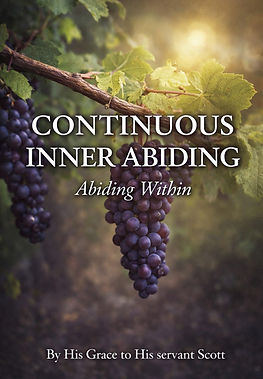
There is a difference between occasionally visiting God and living turned toward Him. Many believers know how to approach God in moments of need, worship, or crisis. Fewer understand what it means to remain inwardly oriented toward Him throughout the day. Continuous inner abiding is not emotional intensity, nor is it constant religious activity. It is the settled posture of a heart that has learned to face God within.
Jesus said in John 15:4, “Abide in Me, and I in you. As the branch cannot bear fruit of itself, unless it abides in the vine, neither can you, unless you abide in Me.” Notice the language — not visit, not perform, not attempt — but abide. A branch does not strain to stay connected to the vine. It lives from that connection. The issue is not effort; it is attachment.
To be continuously turned toward God means that inwardly, the soul has been reoriented. Before Christ, our inward reflex was self-preservation, self-effort, or self-indulgence. After regeneration, the Spirit begins reshaping our reflexes. What once turned quickly toward fear, anger, lust, control, or anxiety now learns to turn toward Him. Romans 8:6 says, “To be spiritually minded is life and peace.” Spiritual mindedness is not mental strain — it is inner direction.
Many exhaust themselves trying to love God through outward acts. They increase activity, increase language, increase visible devotion. But Luke 10:41–42 shows us the contrast between Martha and Mary. Martha was active for Jesus; Mary was positioned before Him. Jesus called Mary’s posture “the one thing needed.” Outward service without inward union eventually produces dryness. Haggai 1:6 describes earning wages and placing them in a bag with holes. When God is not first inwardly, life leaks.
Continuous inner abiding is formed through deliberate returning. Isaiah 30:15 says, “In returning and rest you shall be saved; in quietness and confidence shall be your strength.” At first, returning is intentional. We catch ourselves drifting, reacting, striving — and we gently turn inward again. Over time, this act of returning becomes natural. It becomes reflex. The heart learns where home is.
This abiding is not passivity. Hebrews 4:9–11 speaks of a rest that remains for the people of God, yet it tells us to “be diligent to enter that rest.” There is effort in learning rest. There is intentionality in learning stillness. Psalm 46:10 commands, “Be still, and know that I am God.” Stillness is not inactivity; it is focused awareness. It is the soul actively settled in God.
Even Jesus modeled this. In John 5:19 He said, “The Son can do nothing of Himself, but what He sees the Father do.” Christ was never disconnected from the Father. His outward activity flowed from inward union. He withdrew often to lonely places to pray (Luke 5:16), not because He was disconnected, but to maintain continuous communion. His ministry flowed from abiding.
When our abiding is interrupted — through sin, distraction, emotional turbulence, or overactivity — the solution is not performance. It is returning. First John 1:9 reminds us that if we confess our sins, He is faithful and just to forgive and cleanse us. Confession restores clarity. Repentance restores direction. The mature believer does not panic at interruption; he simply turns back.
Continuous inner abiding creates a steady exchange of love. First John 4:16 says, “He who abides in love abides in God, and God in him.” Abiding is relational circulation. We receive His love; we respond in surrender. We rest in His presence; He produces fruit through us. Galatians 2:20 declares, “It is no longer I who live, but Christ lives in me.” That is abiding language. The life we now live flows from inward union.
This kind of abiding transforms recovery, leadership, and family life. In recovery, abiding interrupts impulsive cycles. Instead of reacting to pain with destructive habits, the heart turns inward first. In leadership, abiding protects against performance-driven ministry. Authority begins to flow from character formed in communion. In families, abiding replaces control with peace, because the soul is no longer grasping for stability — it is anchored.
Jesus concludes in John 15:5, “He who abides in Me, and I in him, bears much fruit; for without Me you can do nothing.” Fruit is not manufactured; it is produced. The branch does not strain to create grapes. It remains connected. Continuous inner abiding is the lifestyle of remaining.
It is not mystical detachment. It is disciplined orientation. It is the heart trained to face God throughout the day — in conversation, in work, in decision, in silence. It is the quiet awareness that He is present and that we live from Him. Acts 17:28 says, “In Him we live and move and have our being.” That is not poetic exaggeration; it is spiritual reality.
When the inward turning becomes continuous, rest deepens. Anxiety lessens. Reaction slows. Love increases. The soul learns that its strength is not found in striving but in staying. Abiding becomes the atmosphere of life. And from that place — steady, inward, surrendered — fruit grows naturally, peace governs consistently, and God is no longer someone we visit, but the One in whom we remain.


