Comfortable In Our Own Skin
January 27, 2026
When Marks On The Outside Try To Speak For The Inside
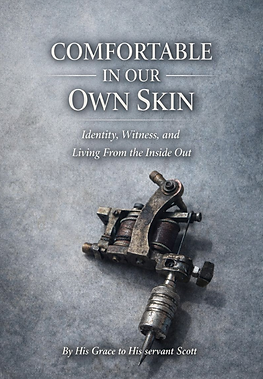
This is not a message of judgment. It’s a message of reflection, honesty, and love. And it’s important to say that upfront. Scripture reminds us that “the Lord looks at the heart” (1 Samuel 16:7), and this writing comes from that place.
I’m not writing this as someone standing on the outside looking in. I have tattoos. A lot of them. I got them years ago, in seasons of rebellion, gangs, anger, and searching for identity in all the wrong places. So this isn’t about pointing fingers — it’s about asking honest questions we don’t often slow down enough to ask, the kind Scripture invites when it says, “Examine yourselves to see whether you are in the faith” (2 Corinthians 13:5).
One of those questions is simple, but uncomfortable: why do we feel the need to mark our bodies? Not in a legalistic sense, but in a human one. Scripture teaches that our bodies matter — “Do you not know that your body is a temple of the Holy Spirit… and that you are not your own?” (1 Corinthians 6:19). If tattoos were always available — and historically, they were — why weren’t entire cultures covered in them the way ours is today? There have always been needles, ink, and methods. But what has changed is not technology — it’s identity. We live in a generation desperate to define itself outwardly because inwardly, so many are unsure of who they are. The Bible describes this restlessness clearly: “All we like sheep have gone astray; we have turned—every one—to his own way” (Isaiah 53:6).
For many people, tattoos are deeply personal, meaningful, and emotional. They represent pain, memory, loss, loyalty, or survival. That matters. Scripture acknowledges that people carry real wounds and stories — “The heart knows its own bitterness” (Proverbs 14:10). But it’s also honest to acknowledge that culturally, tattoos have shifted from rare and symbolic to almost expected. There is now a quiet pressure — especially among younger generations — that if you don’t mark yourself, you’re somehow missing something, behind, or less authentic. Scripture warns us about this kind of pressure: “Do not be conformed to this world, but be transformed by the renewal of your mind” (Romans 12:2). That alone should give us pause.
Whether we want to admit it or not, tattoos often awaken something rebellious in us. Not always in a loud way, but in a subtle one — a declaration of autonomy, control, or resistance. Even when rebellion isn’t the conscious motive, it can still be part of the undercurrent. Scripture reminds us that rebellion isn’t just about rules; it’s about the heart posture that says, “I decide who I am. ” From the beginning, humanity has wrestled with this tension: “You will be like God” (Genesis 3:5). That’s a deeply human struggle, and one every believer must wrestle with honestly.
As we mature in Christ, something begins to shift. The more secure we become in who we are on the inside, the less we feel the need to announce it on the outside. Scripture says, “If anyone is in Christ, he is a new creation” (2 Corinthians 5:17). When our identity is rooted in being known, loved, forgiven, and redeemed by God, the urgency to define ourselves through external markers starts to fade. We become comfortable in our own skin — not because we’ve perfected it, but because we’ve rested in grace. As Paul wrote, “I have learned in whatever situation I am to be content” (Philippians 4:11).
This isn’t about erasing the past or shaming choices already made. God redeems stories — He doesn’t demand rewrites. Scripture is clear: “Where sin increased, grace abounded all the more” (Romans 5:20). Many tattoos become reminders of where God brought us from, not symbols of who we still are. But maturity invites us to ask better questions moving forward. Not “Can I?” but “Why do I want to?” Not “Is it allowed?” but “Is it beneficial?” As Paul said, “All things are lawful for me, but not all things are helpful” (1 Corinthians 6:12). Not “Does this express me?” but “Am I already fully known without it?” — “Before I formed you in the womb I knew you” (Jeremiah 1:5).
The deeper truth is this: when we live from the inside out, we no longer need outward things to complete us. Identity settles. Striving quiets. The need to prove or project diminishes. Scripture calls this maturity: “When I became a man, I put away childish things” (1 Corinthians 13:11). We don’t stop being creative, expressive, or unique — we simply stop needing those things to tell us who we are.
This conversation isn’t about tattoos alone. It’s about rest. About identity. About learning to live from a place of peace instead of pressure. Jesus invites us into this rest when He says, “Come to Me, all who labor and are heavy laden, and I will give you rest” (Matthew 11:28). And when Christ becomes our anchor, we find that we don’t need to mark ourselves to be seen — because we already are marked by and for Him: “Having believed, you were sealed with the Holy Spirit” (Ephesians 1:13).
A Personal End Note
I want to say this plainly and honestly. I don’t celebrate my tattoos. I live with them because they’re on me, but I don’t love them. They came from a season of rebellion, confusion, and misplaced identity, not from clarity or calling. Scripture says, “The times of ignorance God overlooked, but now He commands all people everywhere to repent” (Acts 17:30). I remember a time before tattoos were popular, when people would say things like, “I don’t have tattoos, so I can’t reach the people you reach, ” or “I can’t witness in those circles. ” I believed that for a while too. Looking back now, I realize how wrong that thinking was.
Anointing does not require tattoos. The favor of God does not need ink. Authority does not come from markings on the body — it comes from a surrendered heart. Scripture confirms this: “Not by might, nor by power, but by My Spirit, says the Lord” (Zechariah 4:6). We don’t need external symbols to validate our ability to reach broken people. God has always used yielded hearts, obedient lives, and genuine love to reach the lost — “Man looks on the outward appearance, but the Lord looks on the heart” (1 Samuel 16:7).
Many times, we justify our desire for tattoos by spiritualizing it — as if it somehow enhances our witness or credibility. But the truth is, Jesus doesn’t need our image to do His work. He needs our availability. “Here am I; send me” (Isaiah 6:8). I’ve been in dark places, dangerous places, and hard environments, and I’ve learned this: it’s not what’s on your skin that opens doors — it’s what you carry in your spirit. “The Kingdom of God does not consist in talk but in power” (1 Corinthians 4:20).
This isn’t condemnation. It’s clarity. And it must be said rightly. Scripture assures us, “There is therefore now no condemnation for those who are in Christ Jesus” (Romans 8:1). But that promise is not permission to remain unchanged — it is assurance for those who are walking in surrender, not using grace as a covering for unresolved rebellion. As Paul also warned, “Shall we continue in sin that grace may abound? By no means!” (Romans 6:1–2).
God doesn’t need us to look a certain way to use us powerfully. He only asks for a heart fully His.
I also need to say this honestly: I justified many of my tattoos over time — even getting new ones to cover old ones. Some were done before I knew Christ, and some were done after. I told myself different stories about meaning, purpose, or covering the past. But the Lord made something very clear to me: “Scott, there is no covering this up.” What I learned is that ink doesn’t heal identity, and it doesn’t erase agreement — only truth and repentance do. Whether I was a believer or not at the time, the Lord was showing me that the issue was never the season I was in, but the heart posture I was carrying.
I also want to share something personal and sobering. There was a time when the Spirit of the Lord spoke to me very clearly and said, “Scott, Satan was tattooing you as his.” He then led me back, tattoo by tattoo, starting with the very first one. As I prayed, He brought back the memories — why I got each one, what season I was in, and what I was agreeing with at the time. I realized there was a spiritual timeline written on my body, connected to rebellion, pain, identity, and darkness I didn’t yet understand. One by one, the Lord had me renounce those agreements and bring them under the authority of Christ.
That experience taught me something important: there are spiritual implications happening behind the scenes that we don’t always see. Scripture tells us, “Our struggle is not against flesh and blood, but against the rulers, the authorities, and the spiritual forces of evil” (Ephesians 6:12). Just like when we eat fruit, we can’t see the vitamins and nutrients entering our body — but they are going in — the same is true spiritually. What we participate in, what we agree with, and what we take into ourselves can have unseen effects on the soul and spirit. “A little leaven leavens the whole lump” (1 Corinthians 5:6).
This does not mean God cannot redeem, heal, or restore — He absolutely does. It means that maturity invites us to take spiritual agreement seriously. The gospel is not fear-based, but it is truth-based. And truth does not lead us into condemnation — it leads us into freedom. As Jesus said, “You will know the truth, and the truth will set you free” (John 8:32).


