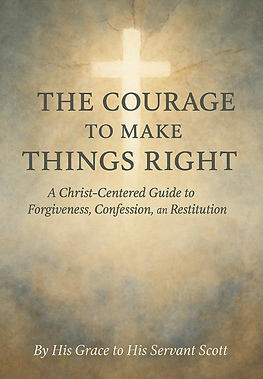
The Courage To Make Things Right
March 22, 2026
The Difference Between Real Amends and Manipulative Apologies
When we hurt someone, something inside us knows the relationship is no longer whole. Most people respond to that discomfort with quick apologies, vague words, or emotional language meant to relieve guilt — not repair the damage. But biblical restoration is different.
True amends are not about easing our feelings; they are about acknowledging the truth, owning what we broke, and honoring the person we harmed. Proverbs 28:13 says, “Whoever conceals his sins does not prosper, but whoever confesses and forsakes them finds mercy.” God doesn’t bless hiding. He blesses honesty.
A manipulative apology sounds like: “I’m sorry you felt that way,” or “I was going through a lot,” or “We both made mistakes.” It shifts blame, minimizes the damage, asks for sympathy, or quietly attempts to regain the relationship. These are not amends — they are strategies to escape consequences. Jesus said in Matthew 5:37, “Let your ‘Yes’ be yes and your ‘No’ be no.” That means clarity, not confusion. Responsibility, not excuses. Truth, not performance.
A true amends letter has three marks. First, it names what you did without spin or self-defense. Second, it acknowledges the pain you caused without demanding anything in return. Third, it releases the other person from any expectation — no hooks, no pressure, no subtle hope they respond the way you want. Real amends say, “What I did was wrong. You did not deserve the impact of my choices. I take full responsibility.” Nothing more. Nothing less. That humility honors God, honors truth, and honors the person.
There is another layer — a deeper one — that many people avoid: restitution. Scripture is clear that when possible, repentance includes repairing what was damaged. In Luke 19:8, Zacchaeus says, “If I have taken anything from anyone by false accusation, I restore fourfold.” That is not legalism. That is love in action. Restitution is saying, “I will make right what I made wrong.” Sometimes restitution is financial. Sometimes it is returning what we took. Sometimes it is rebuilding trust through consistency. Sometimes it is cleaning up a mess we created. Romans 12:18 says, “As far as it depends on you, live at peace with everyone.” Restitution is the “as far as it depends on you.”
Restitution does not guarantee reconciliation. Amends do not guarantee restored relationship. The person you harmed may never respond. They may not trust you again. They may not want connection. And that is their right. Amends are about integrity, not outcome. They are about obedience to God, not controlling someone’s reaction. A mature heart says, “I will do what is right — even if it changes nothing on their side.” That’s what grace looks like lived out.
Sometimes the hardest part is facing our own shame. But Scripture gives us courage: “If we confess our sins, He is faithful and just to forgive us” (1 John 1:9). God does not humiliate those who tell the truth. He heals them. When we take ownership without excuses, when we confess without fear, when we make things right without demanding anything back, we walk in the kind of freedom Jesus describes in John 8:36: “So if the Son sets you free, you will be free indeed.”
True amends are not about the past — they are about the kind of person we are becoming. They are proof that growth is real, that humility has taken root, and that we value people more than our pride. Anyone can say “I’m sorry.” Only the transformed can say, “I was wrong, I accept responsibility, and as far as it depends on me, I will make this right.”
This is the path of peace. This is the way of Christ. And this is how broken relationships find the doorway to healing — one honest, humble, responsibility-filled step at a time.


