When Hope Is Loud
June 20
Protecting the Faith of Desperate New Believers
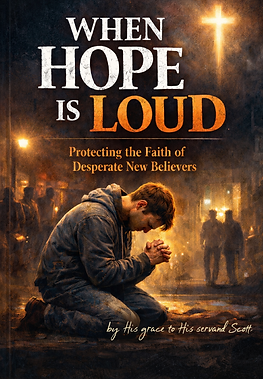
There is a particular kind of faith that shows up in people who come to Christ from extreme places—deep addiction, violence, abandonment, trauma, long years of failure, or despair. It does not arrive polished. It does not speak softly. It is not yet disciplined by maturity or wisdom. It comes loud, urgent, and sometimes overwhelming. And often, it is misunderstood.
These believers are not simply excited. Many of them are afraid. Afraid of losing what they’ve found. Afraid that this, like everything else, might fail them. Afraid of going back to the darkness they barely escaped. So they talk about it constantly. They testify loudly. They bring Jesus into every conversation. They repeat the same phrases again and again, not because they are showing off, but because they are holding on.
In many cases, they are not only proclaiming faith to others—they are preaching it to themselves.
Scripture shows us this pattern clearly. When the woman with the issue of blood touched Jesus’ garment, she had been saying within herself, “If I may but touch His clothes, I shall be whole” (Mark 5:28). Her confession preceded her healing. Her words were not performance; they were survival. The same is true for many new believers. Speaking faith is how they keep fear from swallowing them.
Yet this is often where harm is done—sometimes unknowingly, sometimes carelessly. Well-meaning believers, uncomfortable with the intensity, begin to hush them. “You don’t need to talk about it so much.” “Calm down.” “Just live it.” “You’re being too much.” What sounds like balance to the mature ear can feel like danger to the desperate soul. To them, it sounds like: Don’t touch it too much. Don’t lean too hard. Don’t depend fully. And that is the very thing they cannot afford to hear.
Many of these new believers are also trying to repair or address relationships they damaged in the past. They speak openly to people they’ve hurt. They testify in front of those who know their worst failures. They are not naïve—they are clinging to hope. They are saying, sometimes without realizing it, “Please let this be real. Please let this last.”
The problem is not their passion. The problem is the absence of mature protection around them.
Scripture never instructs us to silence the weak—it commands us to strengthen them. “We then who are strong ought to bear the infirmities of the weak, and not to please ourselves” (Romans 15:1). Bearing means walking with. Covering. Creating safety. Not correcting intensity before stability has formed.
What these believers need is not suppression, but shepherding. Not one conversation, but a relationship. Not a lecture, but a safe zone.
Mature believers are called to come alongside and gently help bring balance over time—helping them learn discernment, boundaries, wisdom in speech, and emotional grounding—without ever communicating that their faith expression is a problem. This does not happen once. It happens through presence. Through walking. Through consistent reassurance that Christ is not fragile, and their salvation does not depend on perfect expression.
Jesus Himself did this. He did not rebuke the demoniac who begged to go with Him—He redirected him with care. He did not silence the blind man crying out—He stopped and called him closer. He did not shame Peter’s impulsiveness before strengthening him. He walked with them until zeal matured into depth.
Desperate faith is not something to be corrected quickly—it is something to be guarded carefully.
Many people forget that hope is loud before it is rooted. Over time, faith will quiet itself—not because it is weaker, but because it is stronger. Roots do not need to shout. But until roots form, the shout is often what keeps the plant alive.
When we encounter loud hope, we should not hush it—we should protect it. Because sometimes, that voice is the thin line between life and going back to death.
And love knows how to stand guard until strength comes.
“A bruised reed He will not break, and a smoking flax He will not quench” (Isaiah 42:3).
Neither should we.
Recent Devotionals


Cuando La Esperanza Se Hace Oír
Proteger La Fe De Los Nuevos Creyentes Desesperados
Hay una clase particular de fe que se manifiesta en las personas que llegan a Cristo desde situaciones extremas: una adicción profunda, la violencia, el abandono, el trauma, largos años de fracasos o la desesperación. No llega pulida. No habla en voz baja. Todavía no está disciplinada por la madurez ni la sabiduría. Llega con fuerza, urgencia y, a veces, de manera abrumadora. Y a menudo se la malinterpreta.
Estos creyentes no están simplemente emocionados. Muchos tienen miedo. Miedo de perder lo que han encontrado. Miedo de que esto, como todo lo demás, también les falle. Miedo de volver a la oscuridad de la que apenas lograron escapar. Por eso hablan de ello constantemente. Dan su testimonio con fervor. Llevan a Jesús a cada conversación. Repiten las mismas frases una y otra vez, no para presumir, sino porque se están aferrando a Él.
En muchos casos, no solo proclaman su fe a los demás: también se la predican a sí mismos.
La Escritura nos muestra claramente este patrón. Cuando la mujer que padecía de flujo de sangre tocó el manto de Jesús, llevaba diciéndose: «Si tan solo toco sus vestidos, seré sana» (Marcos 5:28). Su confesión precedió a su sanidad. Sus palabras no eran una actuación; eran cuestión de supervivencia. Lo mismo ocurre con muchos creyentes nuevos. Hablar con fe es la manera en que evitan que el miedo los devore.
Sin embargo, es precisamente aquí donde a menudo se hace daño, a veces sin darse cuenta y otras con ligereza. Algunos creyentes bienintencionados, incómodos ante tanta intensidad, empiezan a hacerlos callar. «No tienes que hablar tanto de eso». «Tranquilízate». «Simplemente vívelo». «Estás exagerando». Lo que al oído de alguien maduro suena a equilibrio puede sentirse como un peligro para un alma desesperada. Para ellos, suena así: No te aferres demasiado. No te apoyes tanto. No dependas por completo. Y eso es justamente lo que no pueden permitirse escuchar.
Muchos de estos nuevos creyentes también están tratando de reparar o sanar relaciones que dañaron en el pasado. Hablan abiertamente con las personas a quienes lastimaron. Dan testimonio ante quienes conocen sus peores fracasos. No son ingenuos: se aferran a la esperanza. Están diciendo, a veces sin darse cuenta: «Por favor, que esto sea real. Por favor, que esto dure».
El problema no es su pasión. El problema es que no cuentan con la protección de personas maduras a su alrededor.
La Escritura nunca nos instruye a silenciar a los débiles; nos manda a fortalecerlos. «Los que somos fuertes debemos sobrellevar las flaquezas de los débiles y no agradarnos a nosotros mismos» (Romanos 15:1). Sobrellevar significa caminar a su lado. Brindarles cobertura. Crear un entorno seguro. No corregir su intensidad antes de que se haya formado la estabilidad.
Lo que estos creyentes necesitan no es que los repriman, sino que los pastoreen. No una sola conversación, sino una relación. No una reprimenda, sino un espacio seguro.
Los creyentes maduros están llamados a acompañarlos y ayudarlos con delicadeza a encontrar el equilibrio con el tiempo: enseñándoles a discernir, a poner límites, a hablar con sabiduría y a encontrar estabilidad emocional, sin dar nunca a entender que su manera de expresar la fe es un problema. Esto no ocurre de una sola vez. Ocurre estando presentes. Caminando juntos. Dándoles una y otra vez la seguridad de que Cristo no es frágil y de que su salvación no depende de expresarse a la perfección.
Jesús mismo hizo esto. No reprendió al endemoniado que le rogaba que lo dejara ir con Él; con cuidado, lo guio en otra dirección. No hizo callar al ciego que gritaba; se detuvo y lo llamó para que se acercara. No avergonzó a Pedro por su impulsividad antes de fortalecerlo. Caminó con ellos hasta que el fervor maduró y se convirtió en profundidad.
La fe desesperada no es algo que haya que corregir de inmediato, sino algo que hay que proteger con cuidado.
Muchos olvidan que la esperanza hace ruido antes de echar raíces. Con el tiempo, la fe se aquieta, no porque sea más débil, sino porque es más fuerte. Las raíces no necesitan gritar. Pero, hasta que se forman, muchas veces el grito es lo que mantiene viva a la planta.
Cuando nos encontremos con una esperanza que se expresa a gritos, no debemos acallarla; debemos protegerla. Porque, a veces, esa voz es la delgada línea que separa la vida de volver a la muerte.
Y el amor sabe quedarse en guardia hasta que llegan las fuerzas.
«No quebrará la caña cascada, ni apagará el pábilo que humeare» (Isaías 42:3).
Nosotros tampoco deberíamos hacerlo.
当希望高声回响
守护绝望中的新信徒的信仰
有一种特别的信心,常常出现在那些从极端境遇中归向基督的人身上——深陷成瘾、暴力、被遗弃、创伤、长期失败或绝望之中。这种信心并不圆熟,也不轻声细语;它尚未经过成熟与智慧的磨炼。它来势汹汹、迫切,有时甚至令人招架不住。而且,它常常会被误解。
这些信徒并非只是兴奋。许多人心里充满恐惧:害怕失去自己找到的这一切,害怕这件事也会像其他一切一样让他们失望,害怕回到那个他们好不容易才逃离的黑暗中。所以,他们总是谈起这件事。他们大声作见证,把耶稣带进每一次对话里,一遍又一遍地重复同样的话,不是为了炫耀,而是因为他们在紧紧抓住信仰。
很多时候,他们不仅是在向别人宣告信仰,也是在向自己传讲信仰。
圣经清楚地向我们展现了这样的情形。那个患血漏的女人摸耶稣衣裳时,她一直在心里说:“我只摸他的衣裳,就必痊愈”(马可福音 5:28)。她先宣告,后得医治。她的话不是做给别人看的,而是为了活下去。许多初信者也是如此。宣告信心,是他们不让恐惧吞噬自己的方式。
然而,伤害往往就在这时发生——有时是不知不觉,有时则是漫不经心。出于好意的信徒对这种强烈的表现感到不自在,便开始让他们别再说了:“没必要总是说这个。”“冷静点。”“活出来就好。”“你这样有点过头了。”在成熟者听来像是平衡的话,对绝望的灵魂而言,却可能像危险的信号。听在他们耳中,就像是在说:别抓得太紧。别太依靠。别全心倚靠。而这恰恰是他们最承受不起听到的话。
许多这样的新信徒,也在努力修复或处理过去遭到他们破坏的关系。他们坦诚地面对自己伤害过的人。他们在那些知晓自己最不堪失败的人面前作见证。他们并非天真——他们只是在紧紧抓住希望。他们有时甚至没有意识到,自己是在说:“求求你,让这一切都是真的。求求你,让这一切持续下去。”
问题不在于他们的热忱,而在于他们身边缺少成熟稳妥的保护。
圣经从未教导我们要让软弱的人噤声——它命令我们扶持他们。“我们坚固的人应该担当不坚固之人的软弱,不求自己的喜悦”(罗马书 15:1)。担当意味着陪伴同行、给予遮护、营造安全感,而不是在他们尚未站稳脚跟之前,就纠正他们过于强烈的表现。
这些信徒需要的不是压制,而是牧养;不是一次谈话,而是一段关系;不是一场训诫,而是一个安全的空间。
成熟的信徒蒙召陪伴在他们身边,温柔地帮助他们逐渐回归平衡——帮助他们学会分辨、设立界限、明智地言谈,并在情绪上扎稳根基——同时绝不让他们觉得自己的信仰表达有问题。这不是一次就能完成的事,而是要借着陪伴,借着同行,借着不断给予他们这样的安慰:基督并非脆弱不堪,他们的得救也不取决于是否表达得完美。
耶稣亲自这样做过。被鬼附的人恳求跟随祂,祂没有责备他,而是满怀关爱地为他指引了另一条路。瞎子大声呼喊,祂没有让他住口,而是停下来叫他到跟前来。彼得冲动行事,祂没有羞辱他,而是在坚固他之后,继续与他同行,直到他的热忱日渐成熟,化为深厚的信心。
迫切的信心不该被急于纠正,而应当被细心守护。
许多人忘了,希望在扎根之前,往往是响亮的。随着时间过去,信心会渐渐安静下来——不是因为它变弱了,而是因为它变得更坚固了。根不需要高声呐喊。但在根扎稳之前,那声呐喊往往正是让植物活下去的力量。
当我们遇见高声呼喊的希望,不该让它安静下来——而该守护它。因为有时,那声音就是生与重返死亡之间的一线之隔。
而爱懂得守候,直到力量归来。
“压伤的芦苇,他不折断;将残的灯火,他不吹灭。”(以赛亚书 42:3)
我们也不该如此。