Satisfied With God Alone
June 17
Why the Foundation of Our Relationship With God Determines Its Stability
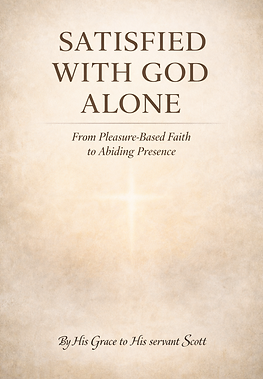
One of the quiet realities in the body of Christ is that many believers sincerely love God, yet their relationship with Him rests largely upon experience rather than communion. Their faith is real, but fragile. It is often stirred and sustained by what brings pleasure—answered prayers, emotional encounters, blessings, relief from pain, or seasons where God feels near and responsive. God frequently uses these things in the early stages of faith, but when pleasure becomes the foundation rather than the fruit, the relationship remains vulnerable. Jesus warned of this when He spoke of those who receive the word with joy but have no root; when trouble or hardship comes, they quickly fall away (Matthew 13:20–21).
This pleasure-based faith is not false Christianity—it is immature Christianity. Paul described believers who were in Christ, yet still spiritual infants, still governed by circumstance and appetite rather than communion (1 Corinthians 3:1–3). When God comforts, faith feels strong. When God withdraws sensible comfort, faith trembles. Remove the emotional reinforcement, and the foundation is exposed. The unspoken question surfaces, as satan once accused of Job: “Does a man fear God for nothing?” (Job 1:9).
Scripture, however, reveals another kind of believer—one whose life becomes increasingly filled with God Himself rather than sustained by what God provides. This believer learns to be satisfied with divine love alone. Their faith no longer depends on stimulation or reassurance. They have learned what the psalmist meant when he said, “Be still, and know that I am God” (Psalm 46:10). Silence becomes communion. Waiting becomes worship. Their stability rests not in feeling, but in presence.
There comes a deeper place still—a place where fear is cast entirely out of the believer’s soul. Scripture declares, “There is no fear in love, but perfect love casts out fear” (1 John 4:18). In this place, fear does not disappear because circumstances improve, but because the soul has been emptied of self-preservation and filled with divine love. What remains is a holy emptiness—an interior space occupied not by desire, anxiety, or self-concern, but by God alone.
In this emptied place, the believer resigns himself fully to whatever divine pleasure decrees. This resignation is not passivity; it is surrender. It is here that the will of God becomes not merely accepted, but desired. Jesus modeled this perfectly: “Not My will, but Yours be done” (Luke 22:42). The believer at this stage is willing to do anything—endure anything, release anything, lose anything—if it means remaining in the presence of God. Obedience is no longer weighed by cost, but by proximity.
This life is not sustained by feeling, but by reality. It is the daily crossing-ending of the self—“I have been crucified with Christ, and I no longer live, but Christ lives in me” (Galatians 2:20). Day in and day out, the believer chooses death to self not dramatically, but faithfully. This is not emotional intensity; it is settled devotion. The heart no longer negotiates with God—it abides.
At this point, the believer’s greatest fear is no longer suffering, loss, or sacrifice. The most horrifying possibility becomes separation from the presence of God. Like Moses, the soul cries, “If Your presence does not go with us, do not send us up from here” (Exodus 33:15). Heaven without God would not be heaven; life without Him would not be life. The soul has found its true home.
This is not an accusation against believers; it is an invitation. God is drawing His people beyond pleasure-based faith into God-centered life. The psalmist describes the destination clearly: “Whom have I in heaven but You? And there is nothing on earth that I desire besides You” (Psalm 73:25–26). This is the unshakable foundation—not experience, not pleasure, not blessing—but God Himself.
Recent Devotionals


Satisfecho Solo Con Dios
Por Qué El Fundamento De Nuestra Relación Con Dios Determina Su Estabilidad
Una de las realidades silenciosas del cuerpo de Cristo es que muchos creyentes aman sinceramente a Dios, pero su relación con Él se basa en gran medida en las experiencias y no en la comunión. Su fe es real, pero frágil. A menudo se despierta y se sostiene gracias a aquello que les causa placer: las oraciones respondidas, los encuentros emocionales, las bendiciones, el alivio del dolor o las temporadas en que Dios parece cercano y dispuesto a responder. Dios suele valerse de estas cosas en las primeras etapas de la fe, pero cuando el placer se convierte en el fundamento, en vez de ser el fruto, la relación sigue siendo vulnerable. Jesús advirtió sobre esto al hablar de quienes reciben la palabra con alegría, pero no tienen raíz; cuando llegan los problemas o las dificultades, enseguida se apartan (Mateo 13:20–21).
Esta fe basada en el placer no es un cristianismo falso, sino inmaduro. Pablo describió a creyentes que estaban en Cristo, pero que aún eran niños espirituales, todavía gobernados por las circunstancias y los apetitos, en lugar de la comunión (1 Corintios 3:1–3). Cuando Dios consuela, la fe parece fuerte. Cuando Dios retira el consuelo perceptible, la fe tiembla. Al quitar el sostén emocional, queda al descubierto el fundamento. Surge la pregunta no expresada que Satanás le planteó a Job: «¿Acaso teme Job a Dios de balde?» (Job 1:9).
Sin embargo, las Escrituras revelan otro tipo de creyente: uno cuya vida se va llenando cada vez más de Dios mismo, en vez de sostenerse en lo que Dios le da. Este creyente aprende a sentirse satisfecho únicamente con el amor divino. Su fe ya no depende de estímulos ni de que le aseguren que todo está bien. Ha aprendido lo que quiso decir el salmista cuando declaró: «Quédense quietos y sepan que yo soy Dios» (Salmo 46:10). El silencio se vuelve comunión. La espera se vuelve adoración. Su estabilidad no se basa en lo que siente, sino en la presencia de Dios.
Aún hay un lugar más profundo: un lugar donde el temor queda completamente desterrado del alma del creyente. Las Escrituras declaran: «En el amor no hay temor, sino que el perfecto amor echa fuera el temor» (1 Juan 4:18). En este lugar, el temor no desaparece porque mejoren las circunstancias, sino porque el alma se ha vaciado del afán de protegerse y se ha llenado del amor divino. Lo que queda es un vacío santo: un espacio interior ocupado no por el deseo, la ansiedad o la preocupación por uno mismo, sino únicamente por Dios.
En este lugar vaciado, el creyente se entrega por completo a todo cuanto disponga la voluntad divina. Esta entrega no es pasividad, sino rendición. Es aquí donde la voluntad de Dios no solo se acepta, sino que llega a desearse. Jesús nos dio el ejemplo perfecto: «No se haga mi voluntad, sino la tuya» (Lucas 22:42). En esta etapa, el creyente está dispuesto a hacer cualquier cosa, soportar cualquier cosa, renunciar a cualquier cosa y perder cualquier cosa, si eso significa permanecer en la presencia de Dios. La obediencia ya no se mide por lo que cuesta, sino por la cercanía a Dios.
Esta vida no se sostiene por los sentimientos, sino por la realidad. Es la crucifixión diaria del yo: «He sido crucificado con Cristo, y ya no vivo yo, sino que Cristo vive en mí» (Gálatas 2:20). Día tras día, el creyente elige morir a sí mismo, no de manera dramática, sino con fidelidad. Esto no es intensidad emocional, sino una devoción firme. El corazón ya no negocia con Dios: permanece en él.
En este punto, el mayor temor del creyente ya no es el sufrimiento, la pérdida ni el sacrificio. La posibilidad más aterradora pasa a ser la separación de la presencia de Dios. Como Moisés, el alma clama: «Si tu presencia no va con nosotros, no nos hagas salir de aquí» (Éxodo 33:15). El cielo sin Dios no sería cielo; la vida sin Él no sería vida. El alma ha encontrado su verdadero hogar.
Esto no es una acusación contra los creyentes, sino una invitación. Dios está guiando a su pueblo más allá de una fe basada en el placer, hacia una vida centrada en Dios. El salmista describe claramente el destino: «¿A quién tengo en los cielos sino a ti? Y fuera de ti, nada deseo en la tierra» (Salmo 73:25–26). Este es el fundamento inquebrantable: no la experiencia, ni el placer, ni la bendición, sino Dios mismo.
唯有上帝,便心满意足
为什么我们与上帝关系的根基决定了这段关系的稳固程度
基督的身体中有一个不为人注意的现实:许多信徒真心爱神,但他们与神的关系却主要建立在经历之上,而非与神相交。他们的信仰是真实的,却也脆弱。信心往往因令人愉悦的事而被激发并得以维系——祷告蒙应允、情感上的触动、蒙受祝福、痛苦得以缓解,或在某些时期感到神亲近且回应及时。神常在信仰初期借着这些事作工;但当喜乐成为根基而非果子时,这种关系就仍然脆弱。耶稣曾警告过这种情形:有些人欢欢喜喜地领受了道,却没有根;一旦遭遇患难或逼迫,就很快跌倒(马太福音 13:20–21)。
这种以喜乐体验为基础的信仰,并非虚假的基督信仰,而是不成熟的基督信仰。保罗描述过一些信徒,他们虽在基督里,却仍是属灵的婴孩,仍受环境和欲望支配,而非活在与神的相交中(哥林多前书 3:1–3)。神安慰人时,信心就显得刚强;神不再赐下可感知的安慰时,信心便动摇。情感上的支撑一旦消失,根基便暴露出来。那句未曾说出口的问题浮现出来,正如撒但曾指控约伯时所问的:“约伯敬畏神,岂是无故呢?”(约伯记 1:9)
然而,圣经也揭示了另一种信徒:他们的生命日渐被神自己充满,而非靠神所赐之物维系。这种信徒学会了单单以神的爱为满足。他们的信仰不再依赖感官上的激励或 reassurance。他们明白了诗人所说的话:“你们要安静,要知道我是神!”(诗篇 46:10)静默成为与神相交,等候成为敬拜。他们的稳固不在于感受,而在于神的同在。
还有一个更深的境地——在这里,信徒的灵魂中一切惧怕都被彻底驱逐。经上宣告:“爱里没有惧怕;完全的爱把惧怕驱逐出去”(约翰一书 4:18)。在这个境地,惧怕消失,并非因为境况有所好转,而是因为灵魂已被掏空,不再自我保护,取而代之的是充满了神圣的爱。留下的是一种圣洁的空无——内心的空间不再被欲望、焦虑或自我牵挂占据,而唯有神居于其中。
在这空无之境,信徒全然顺服于神所定的一切旨意。这种顺服并非消极被动,而是交托。正是在这里,神的旨意不再只是被接受,更成为人所渴望的。耶稣为此作了完美的榜样:“不要成就我的意思,只要成就你的意思”(路加福音 22:42)。达到这一境地的信徒,甘愿做任何事——忍受任何苦难、放下任何事物、失去任何所有——只要能够留在神的同在中。衡量顺服的,不再是代价,而是与神的亲近。
这种生命不是靠感觉维系,而是靠真实。它意味着每日背起十字架、了结自我——“我已经与基督同钉十字架,现在活着的不再是我,乃是基督在我里面活着”(加拉太书 2:20)。日复一日,信徒选择向自我死,不是轰轰烈烈地,而是忠心持守。这并非情绪上的激昂,而是坚定不移的委身。内心不再与上帝讨价还价,而是安住于祂里面。
到了这个阶段,信徒最大的恐惧已不再是苦难、失去或牺牲。最令人恐惧的,变成了与神的同在隔绝。就像摩西一样,灵魂呼求:“你若不亲自和我们同去,就不要把我们从这里领上去”(出埃及记 33:15)。没有神的天堂不成其为天堂;没有祂的生命也不成其为生命。灵魂已经找到了真正的归宿。
这不是对信徒的指责,而是一份邀请。神正引领祂的子民超越以享乐为本的信仰,进入以神为中心的生命。诗篇作者清楚地描绘了这归宿:“除你以外,在天上我有谁呢?除你以外,在地上我也没有所爱慕的”(诗篇 73:25–26)。这才是坚不可摧的根基——不是经历,不是享乐,也不是祝福,而是神自己。