From the Tent to the Heart
July 3, 2026
From God With Us to Christ in Us, The Hope of Glory
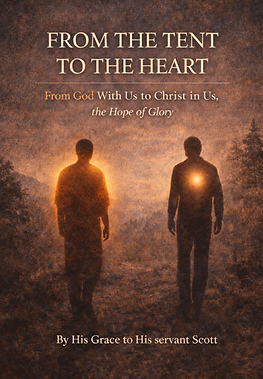
In the Old Testament, the presence of God was real, powerful, and holy—but it was external. God came upon His people. He descended. He filled places. He rested on tents, temples, altars, prophets, priests, and kings. His presence was known, yet limited by location and moment. You went to where God was, and when you left, the encounter stayed behind.
Exodus 33 captures this clearly. God meets Moses at the tent of meeting outside the camp. The cloud descends. God speaks. Joshua remains. Yet when Moses leaves the tent, the people return to their own places. The presence of God is powerful, but it is not carried. It must be revisited. The tent becomes the place where heaven touches earth—but it also reveals a limitation. God is near, yet not within.
This is why the tent mattered so deeply. It was sacred, but it was temporary. It was never meant to be permanent—it was prophetic. It pointed forward to something greater that had not yet come.
Under the Old Covenant, God’s holiness required separation. His presence could come near, but not within. Only certain people, at certain times, in certain ways, could draw close. The presence of God was not denied—it was guarded. Humanity was not yet ready to carry what God desired to give. Sin had not been dealt with fully, and a holy God could not dwell permanently within an unredeemed soul.
This is the crucial truth: the limitation was never God’s desire, but humanity’s condition.
God was willing to dwell with man, but sin created a barrier that could not be crossed by effort, obedience, sacrifice, or ritual. God could visit, empower, and anoint from the outside, but He could not take up residence within fallen man without violating His own holiness. For God to dwell within man, sin itself had to be dealt with—not covered temporarily, but removed.
This is why Christ had to come.
When Jesus comes, He does not pitch a tent outside the camp. “The Word became flesh and dwelt among us” (John 1:14). God steps fully into humanity, not merely to be near us, but to redeem us. Yet even this is not the final movement. Jesus Himself tells the disciples, “It is to your advantage that I go away” (John 16:7). Why? Because what had been with them was about to be within them.
Jesus came as the sin offering. On the cross, sin was judged, condemned, and put away. He did not merely cover sin—He dealt with it fully. Through Christ, the believer is not only forgiven, but cleansed. Righteousness is no longer something man strives for; it is something he receives. Because of Christ, God now sees the believer not through the lens of sin, but through the finished work of the Son.
This is what makes the indwelling presence possible. God does not dwell in man by overlooking sin, but by removing its barrier. In Christ, the believer stands justified, reconciled, and made fit for communion. The Holy Spirit does not enter an unholy vessel—He enters a redeemed one. What was impossible under the Old Covenant becomes reality under the New.
The New Covenant is not about external visitation, but internal habitation. Scripture names it plainly: “Christ in you, the hope of glory” (Colossians 1:27). What Moses entered occasionally, the believer now carries continually. What Joshua learned by proximity, the Christian lives by union. The tent is no longer outside the camp—it is within the heart.
This is not a metaphor. This is reality.
The believer does not travel to find God’s presence; he awakens to it. The Holy Spirit does not descend and depart—He abides. The body becomes the temple. The heart becomes the meeting place. Communion is no longer limited by geography, schedule, or structure. The presence that once required preparation and distance now dwells permanently within the surrendered life.
Yet here is the quiet tension: many believers still live as though they are under the old pattern. They wait for moments instead of practicing awareness. They visit God instead of abiding in Him. They still think in terms of tents, times, and places—when Christ Himself has taken up residence.
The Old Testament teaches us how to approach God. The New Testament teaches us how to remain with God.
This is the beauty of the gospel. God does not merely forgive sin—He restores fellowship. He does not simply cleanse the past—He inhabits the present. Through Christ, the believer becomes a living sanctuary, carrying the presence of God into every place, every conversation, every ordinary moment.
What was guarded is now given. What was external is now internal. What was visited is now inhabited. From the tent to the heart, God has always been moving toward intimacy. And in Christ, He has finally arrived.
1 Corinthians 6:19–20 Or do you not know that your body is a temple of the Holy Spirit who is in you, whom you have from God, and that you are not your own? For you have been bought with a price: therefore glorify God in your body.


